Best time to go: 11–13 July. Wrestling, archery and horseback racing: three ancient skills of the steppe still decide, every July, what it means to be Mongolian.
A Single Festival That Explains an Entire Country
Some countries are best understood in a museum. Others reveal themselves during a national celebration. Mongolia belongs to the latter.
Every July, something remarkable happens. The entire country seems to move at once. The Central Stadium in Ulaanbaatar fills with spectators, small provincial towns host their own competitions, and thousands of horses send clouds of dust rising across the steppe. For a few days, everyday life steps aside, making room for a tradition that brings together almost everyone in the country.
At first glance, Naadam looks like a sporting festival. People wrestle, shoot arrows, and race on horseback. But the longer you stay, the clearer it becomes that these are not simply competitions—they are a story about how Mongolians lived for centuries.
None of the three events was created for entertainment. Each one grew out of necessity. Survival on the steppe demanded confident horsemanship, accurate archery, and strength combined with agility. These skills were passed from parents to children, became part of daily life, and eventually came to symbolize an entire nation.
That is why Naadam is unlike most festivals. It is not a historical reenactment staged for visitors. The past is still alive here. As children prepare their horses, wrestlers step onto the field, and archers draw their bows, Mongolia renews its connection to the way of life that shaped the country.
Three Competitions That Define the Steppe
At the heart of Naadam are just three events. It is remarkable that only three competitions have come to represent the country’s most important celebration.
Mongolian wrestling bears little resemblance to Olympic wrestling. There are no weight classes, so a smaller wrestler may find himself facing an opponent much heavier than he is. Victory does not come through strikes—there are none. A match ends the moment one competitor loses balance and touches the ground with any part of the body above the knee. Sometimes a bout lasts only seconds. At other times, it becomes a patient contest in which both wrestlers wait for a single mistake.
Archery also challenges expectations. Instead of aiming at a round target, competitors shoot at small leather cylinders lined up on the ground. But the most unusual moment comes after a successful shot. The judges do not simply announce the score. They greet each accurate arrow with a long, melodic chant. For a few seconds, the competition feels less like a sporting event and more like an ancient ritual, where every perfect shot is given its own voice.
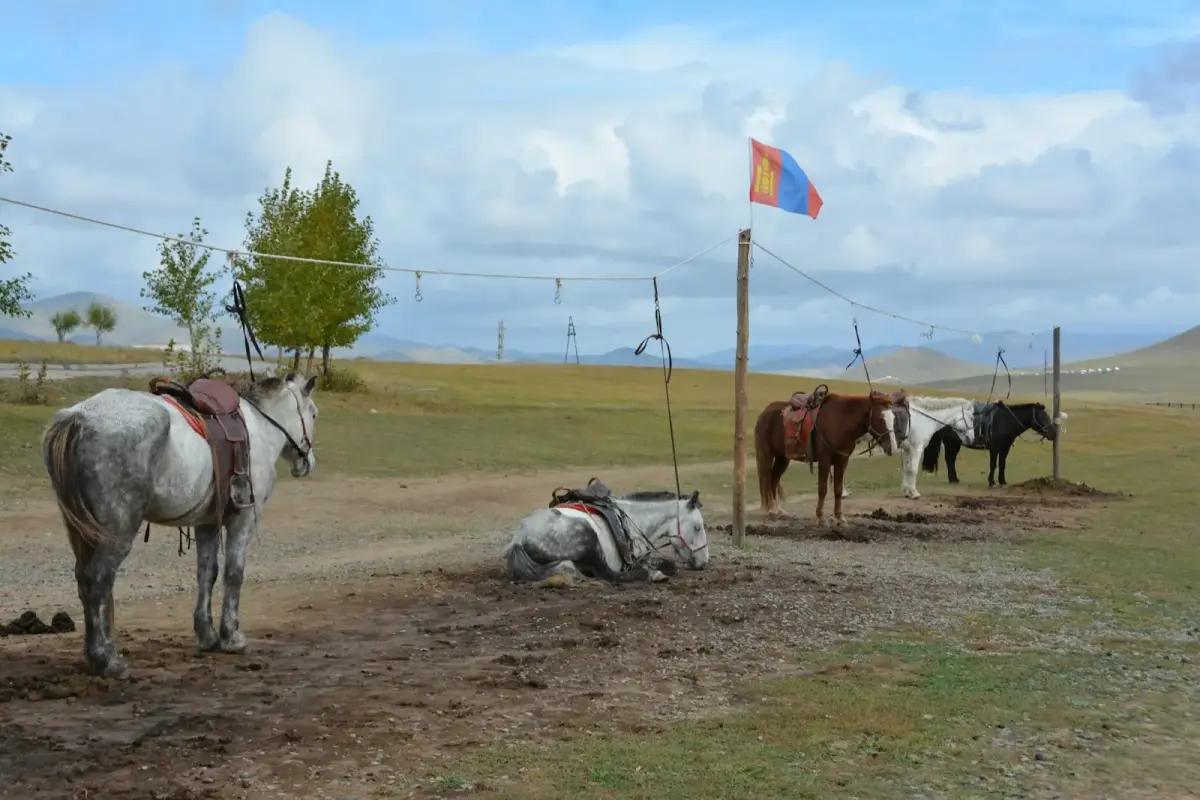
For many visitors, however, the horse races are the most unforgettable part of Naadam. In many countries, the jockey is the star of the race. In Mongolia, the horse takes center stage. It is not seen as sporting equipment but as a true partner. Winning horses are celebrated in songs, and people discuss their bloodlines with as much enthusiasm as the results of the race itself.
At first, these three competitions seem to have little in common. But after spending even a single day at Naadam, a deeper pattern begins to emerge.
Wrestling teaches balance. Archery teaches precision. Horsemanship teaches trust—in both the horse and the endless open steppe.
These were the qualities that allowed people to thrive in a landscape where the nearest neighbor might be dozens of kilometers away and the horizon seemed to stretch forever. That is why Naadam is not really about sport. It is about a way of life that Mongolia still recognizes as part of its identity.
The Young Riders of the Steppe
The horse races are also the part of Naadam that raises the most difficult questions. The riders are usually children, chosen because their light weight allows the horses to run more freely over long distances. Some begin riding almost as soon as they are able to walk, and by the time they enter a race, the saddle already feels like a familiar part of life.
From within Mongolian culture, this is often understood as a continuation of knowledge passed down through families. Children learn how to read a horse’s movements, control their own balance, and remain calm while crossing open country at speed. The race belongs to the horse, but it also reveals the bond between the animal, the child, and the household that trained them.
Yet the tradition cannot be described honestly without acknowledging the debate surrounding it. Long races, unpredictable weather, and crowded courses can be dangerous. In recent years, the age of riders, protective equipment, training conditions, and race safety have become subjects of serious public discussion.
This tension is part of modern Naadam. The festival preserves a nomadic skill, but it must also decide how that skill can continue in a country whose ideas about childhood and safety are changing. Tradition here is not frozen. It is being argued over, protected, and reshaped in real time.
Naadam in the Capital and Naadam on the Steppe
For many visitors, Naadam means the national celebration in Ulaanbaatar. The opening ceremony is formal and carefully staged, the country’s leading wrestlers compete before packed stands, and the arrival of the Nine White Banners connects the festival with the history of the Mongolian state.
This is Naadam at its most ceremonial. It shows how an old tradition has become a symbol of national unity.
But Naadam does not belong only to the capital. Across Mongolia, provinces and small districts hold their own celebrations. These local festivals are usually smaller, less polished, and more closely woven into everyday life. Spectators may know the wrestlers, the horses may belong to neighboring families, and the day feels less like a national spectacle than a gathering of an entire community.
The difference matters. Ulaanbaatar presents the public face of Naadam; the countryside reveals its roots. At a local celebration, there may be fewer decorations and no grand production, but it becomes easier to understand why the festival has survived. It remains connected to families who breed horses, teach children to ride, prepare traditional clothes, and return each year to watch people they know compete.
Seeing both versions gives a fuller picture. One explains what Naadam means to Mongolia as a state. The other shows what it means to the people who have carried it from one generation to the next.
What Happens Between the Competitions
The meaning of Naadam does not live only inside the arena. It is also found in the hours between the races, wrestling bouts, and archery rounds.
Families arrive wearing deels in deep reds, blues, greens, and golds. Relatives who may live far apart meet again. Children run between food stalls, musicians play the morin khuur, and the smell of freshly fried khuushuur settles over the festival grounds.
This is where the event stops looking like a sports tournament. People are not simply waiting for the next result. They are spending the day together, greeting friends, eating, talking, and participating in a shared rhythm that returns every summer.
The traditional arts surrounding Naadam are not decorative additions. Long song, throat singing, music, clothing, craftsmanship, and food belong to the same cultural world as riding, wrestling, and archery. Together they create something larger than a programme of competitions.
For a traveller, these quieter moments can be as revealing as the main events. The stadium shows who wins. The spaces around it show why everyone has come.
The Nine White Banners
One of the most solemn moments of the national Naadam is the procession of the Nine White Banners. Carried into the stadium with military ceremony, they give the celebration a gravity that can seem surprising after the colour and noise of the crowds.
The banners are associated with peace, statehood, and the historical memory of Mongolia. Their presence reminds spectators that Naadam is not only a festival of physical ability. It is also tied to the idea of the country itself.
This is why the opening ceremony matters even to people who are more interested in the races or wrestling. For a brief moment, the festival gathers sport, history, and national identity into a single image. The banners move through a modern stadium, yet they seem to belong to a much older landscape.
Why UNESCO Recognised Naadam
UNESCO added Naadam to its list of intangible cultural heritage in 2010. The recognition was not given simply because the festival is old or visually impressive.
Its importance lies in the network of knowledge that surrounds it. Horses must be raised and trained. Riders must learn balance and endurance. Wrestlers study movements from older competitors. Archery techniques, songs, clothing, food, and customs are passed through families and communities.
Naadam survives because people continue to practise it, not because its objects have been preserved behind glass. Its heritage lives in bodies, habits, voices, and memory.
That distinction is crucial. A ruined palace can remain after the society that built it has disappeared. Naadam cannot. It exists only while people continue to wrestle, ride, shoot, sing, cook, teach, and gather.
How to Experience Naadam Beyond the Opening Ceremony
The national Naadam is held in July, with the principal celebrations in Ulaanbaatar traditionally taking place from 11 to 13 July. The opening ceremony is spectacular, but it should not be treated as the entire festival.
Wrestling is easiest to follow inside the stadium, where the rounds gradually reduce a large field of competitors to a final winner. Archery has a quieter atmosphere and rewards patience. The judges’ calls, the concentration of the archers, and the unusual ground-level targets are easier to appreciate when you stay longer than a few minutes.
The horse races take place outside the city centre, across open ground rather than on a conventional racetrack. Reaching them requires more planning, and the crowds, traffic, dust, and changing weather can make the day less comfortable than photographs suggest. Yet this is where the scale of the steppe becomes part of the event.
A local Naadam can offer a more intimate experience, although dates and arrangements vary between regions. There may be less information in English and fewer facilities, but the connection between the festival and ordinary Mongolian life is often much clearer.
The ideal journey combines both. Begin with the national ceremony in Ulaanbaatar, then see a smaller celebration beyond the capital. One gives you the symbol. The other gives you the living tradition behind it.
What Remains After the Festival
When Naadam ends, the stadium empties, the food stalls disappear, and the horses return to the steppe. What stays with you is not simply the memory of who won.
You remember the wrestler circling the field like a bird before a bout. You remember the voices rising beside the archery targets after a successful shot. You remember children bent low over their horses as the open land seems to rush beneath them.
Gradually, the three competitions begin to look like parts of the same sentence. The wrestler must feel the ground. The archer must judge distance. The rider must move with the horse. Each depends on an exact understanding of the body and the landscape around it.
Naadam does not place Mongolia’s past on display. It allows that past to act, compete, sing, and change.
For several days each summer, the country recognises itself in the strength of a wrestler, the flight of an arrow, and the sound of hooves crossing the steppe.
Why UNESCO Recognised Naadam as Intangible Cultural Heritage
Naadam was inscribed on UNESCO’s Representative List of the Intangible Cultural Heritage of Humanity in 2010. At first glance, it might seem that the festival earned its place because of its age or spectacular appearance. For UNESCO, however, that is not enough.
The true value of Naadam lies in the fact that it continues to exist as a living tradition. It cannot be preserved in a museum display case or reconstructed from old documents. As long as people gather each year to celebrate, raise racing horses, teach children to ride, pass down wrestling techniques, and preserve the traditions of archery, Naadam remains alive. If that chain of knowledge were ever broken, the festival itself would disappear.
That is why UNESCO focuses not so much on the competitions as on the knowledge behind them. Raising a successful racehorse takes years of experience. Becoming a wrestler requires far more than learning the rules—you must inherit techniques from those who came before you. Even making a traditional bow, sewing a deel, or performing Mongolia’s long songs depends on skills that cannot be mastered overnight.
Naadam brings together dozens of traditions like these. Some people raise horses. Others make saddles. Others sew traditional clothing. Musicians play the morin khuur, singers perform long songs, craftsmen make bows, and families prepare festive food. None of these traditions exists in isolation. Together, they form a single cultural world.
That is why Naadam cannot be described as simply a festival. It is one of the rare examples where an entire system of knowledge continues to be passed from one generation to the next, remaining remarkably intact.
Which Naadam Should You Experience?
Most international visitors attend the main Naadam Festival in Ulaanbaatar. If this is your first visit to Mongolia, it is undoubtedly the best introduction to the celebration. This is where the opening ceremony takes place, the country’s strongest wrestlers compete, and participants from across Mongolia gather in one place.
But Naadam has another side.
Nearly every aimag holds its own local celebration. These festivals are much smaller, but they also have far fewer tourists, making it much easier to feel like a guest at a genuine community event rather than a spectator at a large-scale show. Instead of long queues, there are a few hundred spectators. Instead of a vast stadium, there is an open field. Instead of an elaborate official ceremony, there is a celebration created first and foremost for the local community.
If you have enough time, the ideal experience is to see both. Begin with the grand ceremony in the capital, then travel to one of Mongolia’s regions. Only then do you realise that Mongolia’s greatest festival does not end at the gates of the central stadium.
After Naadam
When the festival comes to an end, the crowds disperse, the arenas fall silent, and the horses return to the steppe. Yet Naadam never feels like an event that has simply passed.
What stays with you is not the name of the winning wrestler or the fastest horse, but the feeling of a country that, for a few days each year, seems to return to its roots. People wear the clothing of their ancestors, songs that have been sung for centuries fill the air, and children continue to learn the same skills that generations before them once learned.
Perhaps that is why Naadam leaves such a lasting impression. It does not try to recreate Mongolia’s past. Instead, it allows you to see that part of that past is still alive today.
And when the last riders disappear beyond the horizon, one thing becomes clear: Naadam is not really a story about three competitions. It is the story of a country that has managed to preserve its connection to the steppe, even in the twenty-first century.