In the final days of October, Mexico begins to smell of flowers and smoke. Markets fill with armfuls of orange marigolds, bakeries display round loaves decorated with bone-shaped pieces of dough, and families clear a space in their homes for photographs of those who can no longer be invited to the table in the ordinary way.
Smiling skulls appear in shop windows. Paper skeletons hang above the streets, and women with painted white faces resemble elegantly dressed figures from the afterlife. Yet Día de los Muertos—the Day of the Dead—does not turn death into entertainment or use bright decorations to conceal grief. Its central idea is much quieter: a person does not disappear entirely while someone still remembers what they liked to eat, what made them laugh, and where they used to sit.
During these days, the living prepare to welcome the dead as though they were truly returning home.
Best time to go: 1–2 November. In the last days of October, Mexican homes fill with marigolds and candlelight as families prepare not to say goodbye, but to welcome someone home.
Why Is Death Allowed to Smile Here?
In many cultures, death is kept apart from ordinary life. It belongs to cemeteries, mourning clothes, and conversations held in lowered voices. In Mexico, it may appear on a market stall as a sugar skull, dance through a street procession, or become the subject of a playful poem addressed to someone who is still very much alive.
This does not mean that Mexicans grieve less deeply. Rather, death is not allowed to take everything from a person: their character, their habits, their sense of humour, and their place within the family.
That is why the skeletons of Día de los Muertos rarely look frightening. They play musical instruments, prepare food, ride bicycles, and wear elaborate hats. They continue to inhabit the same world of routines, pleasures, and weaknesses that belonged to them in life.
In this way, death is reduced to human proportions. It remains inevitable, but it no longer feels like a nameless darkness.
An Altar Where Nothing Is Accidental
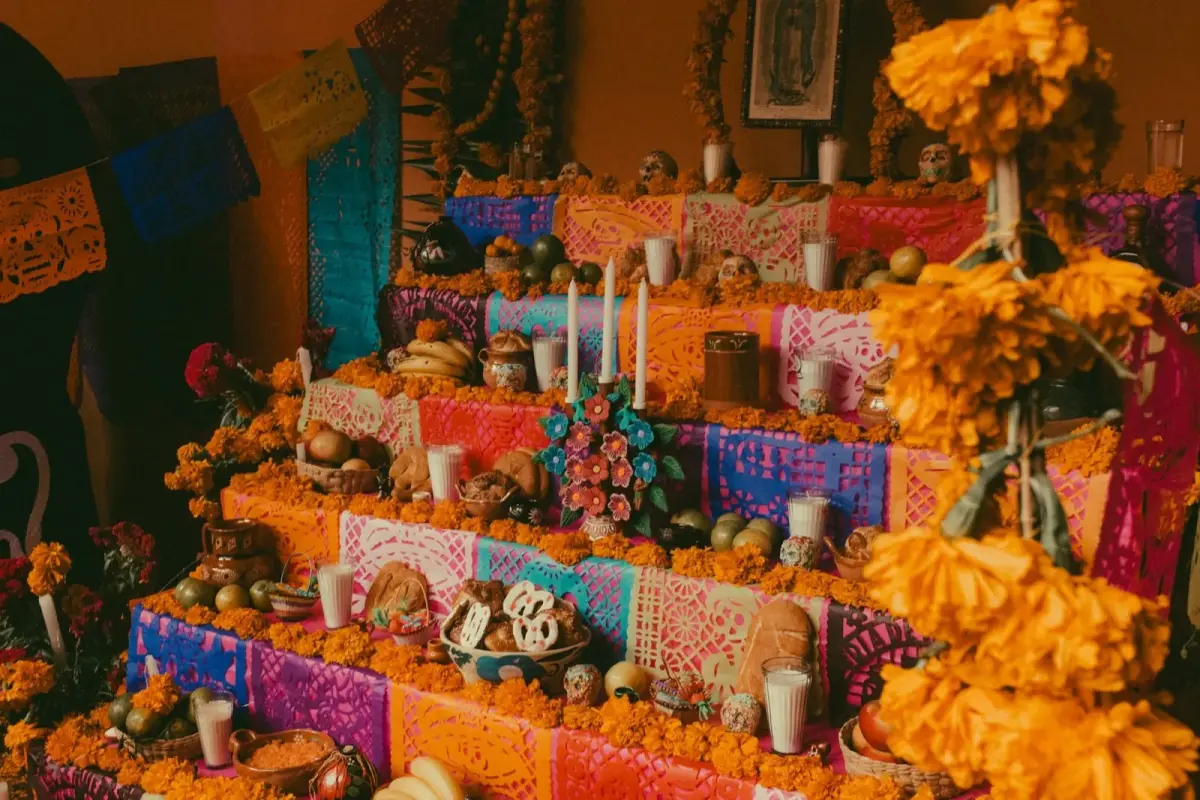
The heart of the celebration is not found in a parade, but inside the home. Here, families create an ofrenda—an offering for the dead, commonly described as an altar.
A photograph is placed alongside candles, flowers, water, and food. But this is not a universal arrangement that can simply be copied from a set of instructions. A meaningful ofrenda resembles a portrait assembled without a single written description.
If a grandfather preferred a particular brand of cigarettes, a packet may be placed beside his photograph. If a grandmother was known for making a certain sauce, the family will prepare that exact dish. A child may receive a toy, a musician an instrument or a record, and someone with a fondness for sweets the confectionery they once loved.
The value of these objects does not lie in their beauty, but in their precision. The dead are not welcomed as anonymous souls. They return as particular people whose tastes and habits are still remembered.
Water is offered to quench their thirst after the long journey. Candles light the way, while petals of the marigold known as cempasúchil may form a path from the entrance to the altar. Their vivid colour and strong scent are believed to help the dead find their way home. Nearby hangs delicate papel picado: cut tissue paper that moves with the slightest current of air, recalling the fragility of life.
UNESCO describes the tradition as a temporary return of the dead to their families. In some communities, petals, candlelight, and offerings form a symbolic path between the home and the cemetery, while favourite dishes are placed both on domestic altars and beside graves.
Why Do Some Return Before Others?
The Day of the Dead is generally associated with 1 and 2 November, but the celebration does not always fit neatly into two identical days. Customs vary between regions, towns, communities, and families.
In a widely observed tradition, 1 November is dedicated to deceased children, known as angelitos—“little angels”—while adults are remembered on 2 November. In certain places, separate days may be reserved for those who died in accidents or for children who died before being baptised.
The calendar therefore becomes a sequence of arrivals. Each soul has its own appointed time, and each family has the opportunity to prepare for its return.
This detail reveals how far the tradition is from a mass festival in which everyone disappears into the same crowd. Día de los Muertos is composed of thousands of private histories. To a visitor, there may be thousands of candles. To the person who lit one of them, it carries a particular name.
A Night Spent Beside the Dead
In some parts of Mexico, the most important moment of the celebration takes place not in a city square but in a cemetery. Families clean the graves, bring flowers, light candles, and remain with the dead for several hours—sometimes until morning.
They may pray, talk, eat, or listen to music. A favourite song of the deceased may be played beside the grave. Elsewhere, relatives simply sit in silence while candlelight flickers across the glass covering a framed photograph.
For a traveller, such a night may seem to bring together two things that should be impossible to combine: private grief and public celebration. One family is laughing, another is praying, while a third carefully rearranges the flowers. No one is expected to feel a single prescribed emotion.
It would therefore be misleading to describe the Day of the Dead as a cheerful rejection of sorrow. Grief is present, but it is not left alone. Beside it stand gratitude, food, family stories, and the possibility of speaking a person’s name once more as though they still belonged to the present.
Where Did Día de los Muertos Come From?
The celebration does not have one simple origin. The tradition known today incorporates Indigenous Mesoamerican beliefs about the relationship between the living and the dead, as well as the Catholic observances of All Saints’ Day and All Souls’ Day introduced by the Spanish.
UNESCO’s official description speaks of the meeting of two worlds: Indigenous belief systems and Catholic rituals that arrived after the European conquest. The festive period also coincided with the end of the annual maize-growing cycle, connecting remembrance not only with family, but with the land, the harvest, and the continuation of life.
However, the familiar claim that the Day of the Dead is an ancient Aztec festival preserved unchanged is too convenient to be entirely accurate. Scholars continue to debate which elements of the modern tradition can be traced to pre-Hispanic rituals and which developed later under European religious influence. Even within Mexico’s National Institute of Anthropology and History, researchers have challenged the idea of a simple, direct line between ancient ceremonies and the celebration seen today.
Perhaps the strength of Día de los Muertos lies precisely in the fact that it has never remained unchanged. Over several centuries, different ideas about death did not erase one another. Instead, they formed a tradition that continues to evolve with the society that carries it.
The Woman Who Dressed for Her Own Death
One of the celebration’s most recognisable figures is not ancient at all. La Catrina—a tall female skeleton wearing an extravagant hat—was born from political and social satire.
The Mexican printmaker José Guadalupe Posada created La Calavera Garbancera, a skull wearing an elegant European-style hat. The image mocked people who tried to imitate the upper classes while denying their own origins. Later, Diego Rivera gave the skeleton a complete body and placed her in his famous mural Dream of a Sunday Afternoon in Alameda Central. In this way, a satirical drawing gradually became a national symbol.
Posada’s central joke was mercilessly simple: an expensive hat cannot change the fact that there is a skull beneath it. In death, social position, wealth, and pretence lose their meaning.
Today, people paint their faces in the style of La Catrina, create elaborate costumes, and join public processions. The image has become far more theatrical than Posada’s original print, yet the old mockery of human self-importance remains inside it.
Why Did UNESCO See More Than a Beautiful Celebration?
The tradition was proclaimed a Masterpiece of the Oral and Intangible Heritage of Humanity in 2003 and entered on the Representative List of the Intangible Cultural Heritage of Humanity in 2008. The recognition does not apply indiscriminately to every modern parade or costume event associated with the Day of the Dead. It refers above all to the observances maintained within Mexico’s Indigenous communities.
Its importance lies neither in the number of flowers nor in the complexity of the altars. The celebration sustains the relationship between generations and confirms the place of the dead within the community.
A child may never have met the person whose photograph stands on the altar. Yet the child learns what that person loved, how they lived, and why the family continues to speak about them. Memory is passed on not as a list of dates, but through a particular dish, a family joke, and an object that returns to the same place each year.
An ofrenda, then, is not built only for the dead. It also helps the living understand whose stories have shaped their own lives.
Where Can You See the Different Faces of the Celebration?
There is no single “correct” place to experience Día de los Muertos. In different parts of the country, it follows a different rhythm.
In Oaxaca, the celebration moves visibly into the streets. Comparsas—processions featuring music, dancing, giant figures, and costumes—pass through the city. Oaxaca offers a striking introduction, combining domestic altars with the public side of the festival, although it also attracts large numbers of visitors.
The area around Pátzcuaro and Lake Pátzcuaro in the state of Michoacán is particularly known for the nighttime vigils held by Purépecha communities. Candles, cemeteries, and the presence of the lake create a powerful atmosphere, but the region’s fame has also brought considerable tourist pressure. Oaxaca and Michoacán represent two of the country’s most prominent yet very different expressions of the tradition.
In Mexico City, visitors can see monumental altars, exhibitions, and a vast parade. This is the most accessible and spectacular version of the celebration, but it should not be mistaken for an exact continuation of an ancient tradition. The capital’s large-scale parade only became an official annual event in 2016.
Smaller towns and villages may offer a more intimate experience, but they demand greater sensitivity. A cemetery remains a place where a particular family is spending time with its dead, not a setting created for tourists.
How Do You Avoid Turning Someone Else’s Memory into Your Photograph?
The most important rule is not to assume that an open space automatically gives you permission to enter someone else’s ritual.
Do not point a camera at a person while they are praying, move objects on an altar, or position yourself between a family and a grave for the sake of a photograph. It is always better to ask before taking pictures, particularly when children are present or when photographs of the deceased are visible.
In cemeteries, speak quietly and take care not to step on decorated graves or paths made from flower petals. Alcohol, music, and laughter may form part of a family’s evening, but that does not give a visitor permission to behave as though they were attending a street party.
Nor should every family be expected to explain the meaning of what they are doing. Some people are happy to speak with travellers; others have come to spend the night only with those closest to them. Respect begins with recognising that not every important moment is intended for an audience.
What Remains After the Journey?
Día de los Muertos is often presented to travellers through skulls, candles, and orange flowers. All of these are real, and together they can create an extraordinary sight. Yet the central experience begins only when the celebration is no longer viewed as a beautiful spectacle.
Gradually, it becomes clear that the flowers are not merely decoration. The food has an intended recipient. The photograph has a name. Even the empty place before the altar does not feel completely empty.
The tradition does not promise to defeat death. It simply refuses to let death reduce a human being to an absence.
Perhaps this is why, at the beginning of November, Mexican homes are not preparing to say goodbye. They are preparing for someone to return.