On the evening of June 23, Spain begins to change.
People carry food, firewood, and folding chairs to the beaches. Barriers are checked around enormous sculptures standing in town squares. In Galicia, families gather herbs and leave them soaking in bowls of water. Elsewhere, people write down what they want to leave behind and wait for darkness to fall.
Within a few hours, hundreds of bonfires will be lit across the country. Yet nowhere will the celebration look exactly the same.
In one city, flames will consume monumental works of art. In another, neighbors will leap over small fires. Along one coastline, crowds will welcome midnight with music and fireworks. Along another, people will step into the cold Atlantic, believing that the sea on this particular night can wash away the past.
San Juan does not unite Spain through a single tradition. Instead, it reveals just how many different ways one country can experience the same night.
Best time to go: 23–24 June. On one midsummer night, Spain lights hundreds of bonfires — and no two towns burn, bathe or wish upon them quite the same way.
A Celebration That Carries Several Centuries at Once
Today, San Juan is associated with the Feast of Saint John the Baptist, celebrated on June 24. Yet many of its customs are far older than the Christian holiday itself, tracing their roots to the summer solstice, the turning point after which daylight in the Northern Hemisphere slowly begins to shorten again.
Long before Christianity, people lit fires, turned to water, gathered medicinal plants, and sought protection from forces they could not explain. Over the centuries, those rituals blended with Christian traditions and local customs, creating the celebration that exists today.
That is why trying to find a single origin for San Juan is almost impossible. It is at once a religious feast, an echo of ancient solstice rituals, a community festival, and a deeply personal opportunity to begin again.
Fire is meant to consume what no longer belongs in your life. Water symbolizes renewal. Herbs promise protection. But every region of Spain gives those symbols its own meaning.
Alicante: Building Something Meant to Burn
In Alicante, San Juan begins long before the first flame appears.
Throughout the city, enormous artistic monuments known as hogueras are raised in streets and squares. Built from wood, papier-mâché, and paint, they depict elaborate scenes filled with satire, humor, and social commentary. Politicians, celebrities, current events, and everyday life all become subjects for artists whose creations are as witty as they are spectacular.
For several days, the city becomes an open-air gallery. People wander from one monument to another, admiring the craftsmanship, searching for hidden details, debating their favorites, and photographing works that will soon disappear forever.
Because everyone already knows how the story ends.
On the night of June 24, the cremà begins. One after another, the monuments are set on fire. Paint blackens, faces twist in the heat, and sculptures that took months to build collapse into ash within minutes.
That is precisely the point.
In Alicante, the fire is not fed with old furniture or unwanted belongings. It is given works of art created specifically to be destroyed. Their beauty comes not despite their short life, but because of it. Knowing they will vanish forever makes people look more closely while they still can.
As the flames grow higher, firefighters spray nearby buildings—and often the crowds themselves—with powerful jets of water. What begins as protection soon turns into celebration. Locals cheer as they are soaked in the traditional banyà, a joyful finale where the intensity of the fire gives way to laughter and relief.
Alicante celebrates San Juan on the grandest possible scale: through art, satire, fireworks, music, and the acceptance that even the most beautiful creations are sometimes meant to last only a few days.
Galicia: A Night by the Cold Atlantic
On the opposite side of Spain, the same fire tells a very different story.
In Galicia, bonfires are lit beside the Atlantic Ocean, where even in late June the water remains surprisingly cold and the evening breeze carries the scent of smoke across the beaches. Here the celebration is known as Noite de San Xoán, and it preserves one of the strongest connections to the region’s traditional folklore.
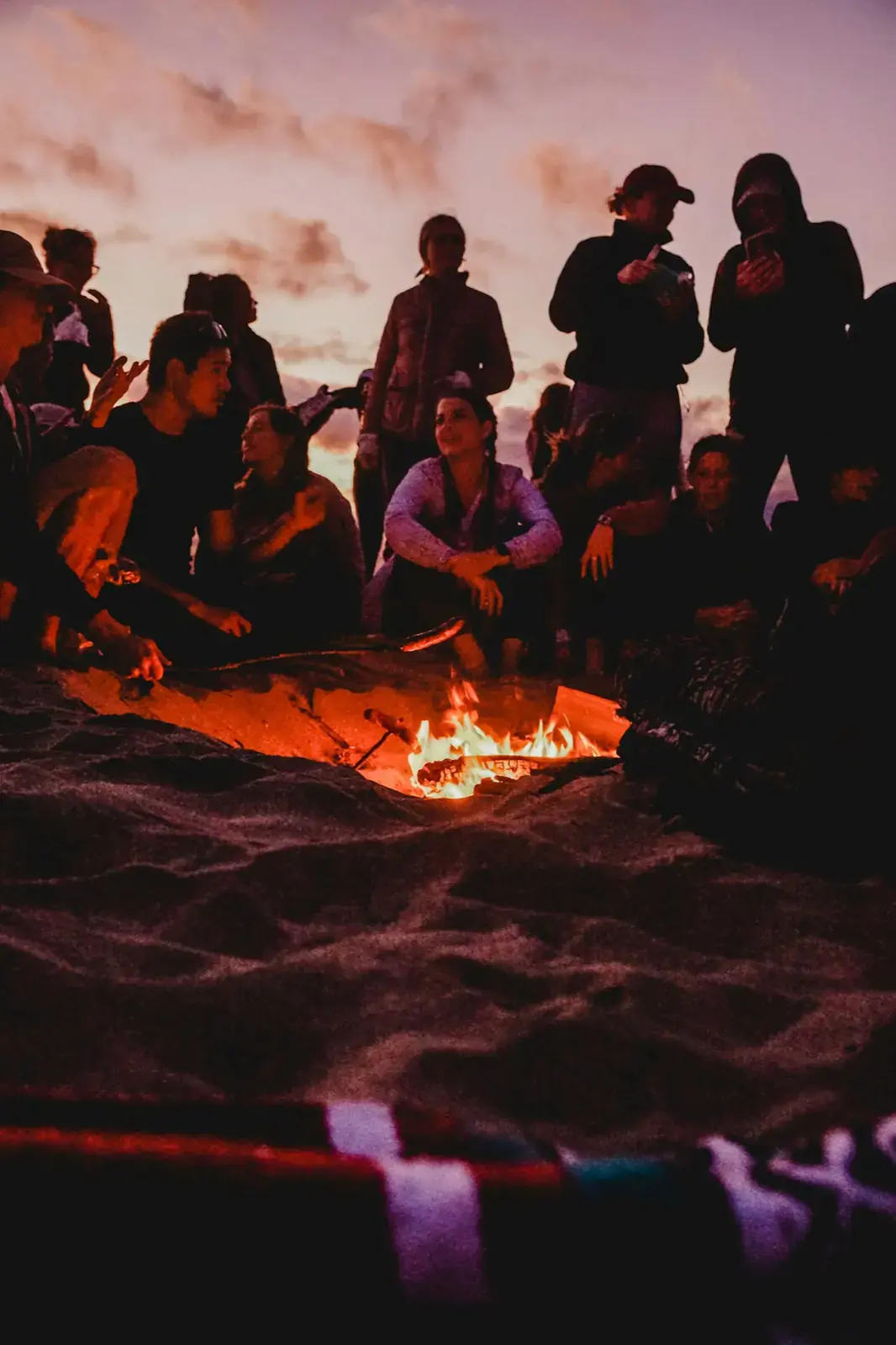
In A Coruña, thousands of people gather on the beaches of Riazor and Orzán. The air smells of grilled sardines, bagpipes can be heard in the distance, and bonfires begin to glow one after another across the sand.
People jump over the flames, although the number of jumps and the meaning behind the ritual vary from place to place. For some, it is a way of leaving misfortune behind. For others, it is believed to bring protection during the coming year. And for many, it is simply something their families have always done, even if the original meaning has long been forgotten.
But in Galicia, fire is only half of the celebration.
Flowers and aromatic herbs—such as St. John’s wort, rosemary, fennel, and vervain—are placed in bowls of water and left outdoors overnight. At sunrise, people wash their faces with the infused water, believing it brings health, protection, or good fortune.
Unlike the bonfires, this ritual is quiet and deeply personal. It happens at home, in gardens, on balconies, or in small courtyards. While music and fireworks fill the beaches, somewhere nearby a bowl of herbs sits silently beneath the night sky, waiting for morning.
That is what makes the Galician San Juan unique. It exists somewhere between celebration and reflection, between smoke and seawater, between the roar of a crowded beach and the quiet ritual of welcoming a new day.
The Mediterranean Coast: Midnight by the Sea
Along Spain’s Mediterranean coast, the celebration gradually moves toward the water.
In Catalonia, the night is known as Revetlla de Sant Joan. In the Valencian Community, Andalusia, and other coastal regions, local versions of the festival fill beaches, promenades, and town squares with people long before midnight.
As evening falls, the shoreline begins to resemble an enormous open-air living room. Families and friends bring food, music, and folding chairs. They talk, laugh, watch fireworks burst above the sea, and wait together for midnight. For one night, the usual boundary between the city and the beach simply disappears.
In some places, people step into the sea exactly at midnight. Elsewhere, they jump over the waves while making a wish. In other towns, people write down what they want to leave behind and throw the paper into an authorized bonfire.
There is no universal ritual.
San Juan does not ask everyone to follow the same traditions. It simply invites people to decide what this night will mean to them.
It is also worth remembering that San Juan has become one of Spain’s busiest summer celebrations. Popular beaches are packed until sunrise, music continues throughout the night, and many municipalities strictly regulate where bonfires may be lit because of wildfire risks and environmental concerns.
That does not make the celebration any less authentic. It simply means that, on the Mediterranean coast, San Juan has become both an ancient tradition and one of the biggest nights of the Spanish summer.
What People Really Leave Behind
Perhaps the most fascinating part of San Juan begins after the official celebrations fade into the background.
Someone writes down a wish.
Someone else writes the name of a person they are ready to forget.
Another person writes down a fear, a bad habit, or a painful memory they no longer want to carry into the future.
The paper burns in only a few seconds.
Of course, the past does not disappear with it. But for a brief moment, people watch their worries turn into ashes, and sometimes that symbolic gesture is enough to make change feel possible.
Water serves the opposite purpose.
People do not give something to the sea—they ask something from it. Health. Luck. Protection. A fresh beginning. Some walk into the water at midnight. Others jump over the waves. In Galicia, many wash their faces the following morning with water infused overnight with herbs.
Even those who no longer believe in the magical power of fire or water continue to take part.
Perhaps the rituals survive not because everyone believes they truly work, but because people sometimes need a visible gesture to mark an invisible decision.
Which San Juan Should You Choose?
If this is your first San Juan, do not try to experience every version of the celebration in a single trip. Although they all take place around the same date, they offer completely different experiences.
Choose Alicante if you want to witness one of Spain’s largest and most spectacular festivals. Monumental sculptures, fireworks, parades, music, and the unforgettable cremà create an atmosphere unlike anything else in the country.
Choose Galicia if you are more interested in tradition than spectacle. Here, San Juan remains closely connected to local folklore, Atlantic bonfires, herbs, and rituals that have been passed down through generations.
Choose the Mediterranean coast if you want to spend the shortest night of the year on the beach. In Catalonia, Valencia, and many coastal towns, San Juan is celebrated barefoot on the sand with music, fireworks, and midnight swims.
Choose a small town or village if you prefer quieter celebrations. In many parts of Spain, San Juan is still centered around a single neighborhood bonfire where families, friends, and neighbors gather year after year. It feels less like a public event and more like a tradition that belongs to the community itself.
A few practical tips can also make your trip much easier. The main celebrations almost everywhere begin on the evening of June 23 and continue until dawn on June 24, so arriving the day before is the best option. Accommodation in popular destinations—especially Alicante and major coastal cities—often sells out well in advance. If you want a good view of the cremà or plan to celebrate on a famous beach, arrive several hours early, as the best spots fill up quickly.
In the end, your biggest decision is simply this: would you rather spend San Juan surrounded by giant burning monuments, beside the cold Atlantic Ocean, or barefoot on a Mediterranean beach?
All three experiences are called San Juan.
None of them feels quite the same.
One Night, Experienced a Thousand Different Ways
By morning, the bonfires have burned down. Ash covers the streets of Alicante. The beaches slowly empty. In Galicia, bowls of herbs are brought back inside, ready for the morning ritual.
Nothing in the world has truly changed.
Old problems have not disappeared. Wishes have not magically come true. The Atlantic remains just as cold as it was the night before.
And yet, every year, Spain lights the fires again.
Perhaps because people have always needed moments that separate “before” from “after.”
Once a year, Spain creates that moment with fire, washes it with seawater, and leaves the scent of herbs lingering until sunrise.
Hundreds of bonfires are lit on the same night.
But every person brings something different to the flames.