Best time to go: Workshops open year-round. For centuries an entire island kept one secret: how to turn molten glass into objects that could rival royal treasuries.
When Craftsmanship Was More Valuable Than Gold
Today, glass is everywhere. We use it so often that it is difficult to imagine a time when a clear glass vase or a delicate drinking glass was considered a luxury.
Several centuries ago, that was exactly the case. Glass from Murano was sought after by European rulers, wealthy merchants, and noble families. Yet the most valuable treasure was never the goblets, mirrors, or chandeliers themselves. It was the people who knew how to make them.
That is why the story of Murano glass begins not with art, but with a secret.
Why Glassmakers Were Moved to an Entire Island
In 1291, the Venetian Republic ordered all glass furnaces to be relocated from Venice to the nearby island of Murano.
The official explanation was straightforward. Much of medieval Venice was built from wood, and the furnaces posed a constant fire risk.
But there was another reason as well. Concentrating the finest glassmakers on a single island made it much easier to protect the techniques that had made Venetian glass unlike anything else in Europe.
For centuries, these skills were passed from master to apprentice. The greatest treasure of Murano was never the finished objects—it was the knowledge required to create them.
An Art That Cannot Be Paused
A glassblower’s work begins long before the finished piece takes shape. But the most important part unfolds in just a few minutes.
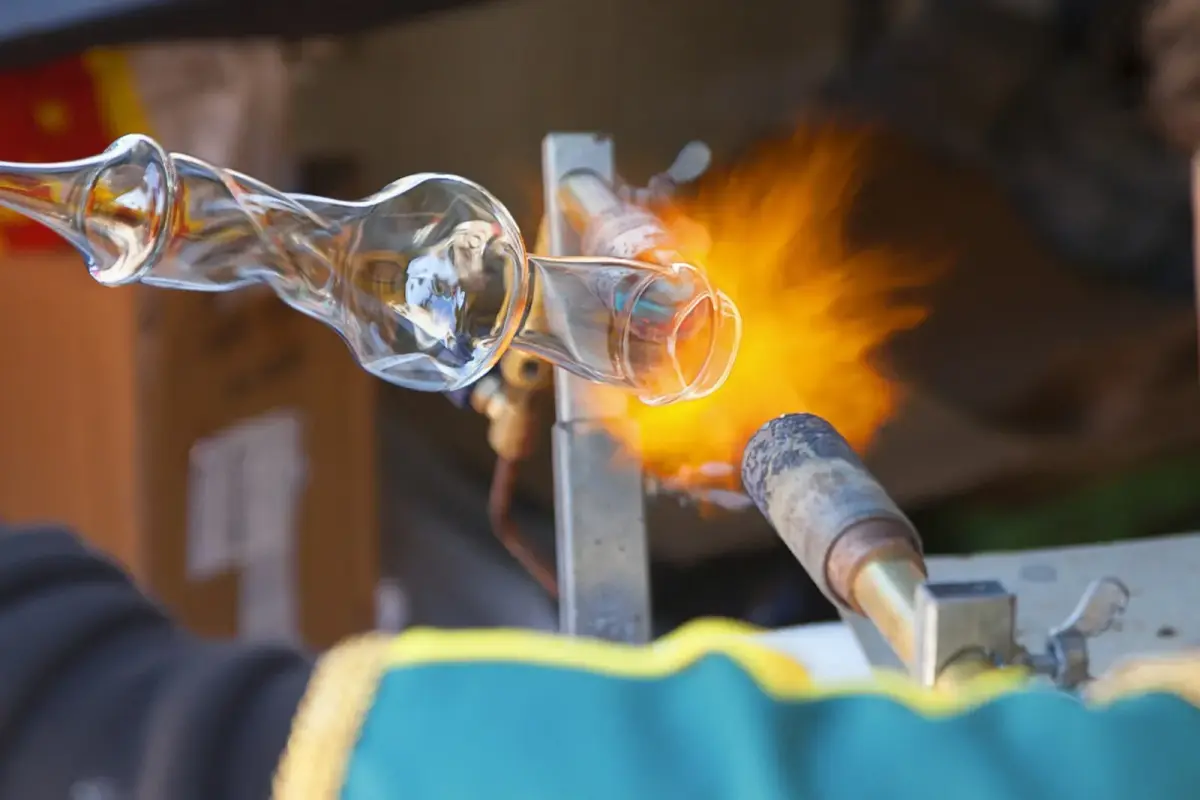
The master gathers a glowing mass of molten glass from the furnace. From that moment on, the material is constantly changing. With every passing second, it cools, becomes less flexible, and gradually loses its ability to be shaped.
There is almost no opportunity to stop.
You cannot pause to think. You cannot undo a mistake. Once the glass has cooled too much, the process must begin again.
Every movement has to happen at exactly the right moment.
How a Shapeless Mass Becomes a Work of Art
The most remarkable thing about Murano glass is not the finished vase, but watching it come into existence.
Only moments earlier, there was nothing more than a glowing sphere of molten glass. Then the master begins to rotate the blowpipe, inflate the glass with a breath of air, stretch it, reheat it, pull delicate details into place, add new layers, and continue working in one fluid sequence.
While the glass is hot, it behaves almost like thick honey. It can be stretched into fine threads, shaped into delicate petals, or expanded into a large, transparent vessel.
Just a few minutes later, the material hardens forever.
For many visitors, witnessing that transformation is the most unforgettable part of the experience.
Why No Two Pieces Are Ever Exactly the Same
Modern manufacturing strives for perfect uniformity. Every product is expected to be an exact copy of the last.
Murano glass follows a different philosophy.
Even when a master creates the same design again and again, every piece is slightly different. The final result is shaped by the temperature of the glass, the rhythm of the work, the force of each breath, and countless subtle movements of the hands.
That is why the finest Murano creations are valued not simply as beautiful decorative objects, but as unique works of art that can never be reproduced with complete precision.
Where to Experience Murano Glass Today
The best place to discover this tradition is not a shop, but a working glass studio.
Many workshops on Murano welcome visitors for live demonstrations, allowing them to watch the entire process—from glowing molten glass to a finished piece. After seeing it with your own eyes, even the most ordinary glass objects begin to look different.
The Murano Glass Museum is also well worth a visit. Its collection reveals how techniques and artistic styles have evolved over the centuries.
Even so, the most memorable experience is often standing beside a blazing furnace, watching a formless mass of molten glass become a delicate work of art within minutes.
Why UNESCO Protects the Craft, Not the Glass
When looking at a finished vase or goblet, it is easy to forget that it exists because of knowledge passed down from one generation to the next for centuries.
That is why UNESCO did not recognize Murano vases, chandeliers, or drinking glasses themselves. What it chose to protect is the craft of glassmaking—the mastery, experience, and deep understanding of a material that changes from one second to the next.
A glass vase can be shattered in an instant.
But as long as there are craftspeople capable of transforming molten glass into works of extraordinary beauty—and passing those skills on to future generations—the tradition of Murano will continue to live.