Best time to go: Museums & studios, year-round. In China, handwriting became a fine art centuries ago — one where a single irreversible brushstroke can carry a lifetime of discipline.
When Writing Became More Than a Way to Record Words
Beautiful handwriting is appreciated in many parts of the world. It reflects care, patience, or a good education. Yet almost nowhere has writing itself become an independent art form.
China is a remarkable exception. Here, calligraphy is studied for decades, exhibited in museums, sold at auctions, presented as a meaningful gift, and collected alongside paintings. A great work is valued not only for what it says, but for the way those words were brought to life.
That is why Chinese calligraphy was inscribed on UNESCO’s Representative List of the Intangible Cultural Heritage of Humanity. But to understand that decision, it is not enough to admire the finished work. You need to see how it comes into being.
The Art Begins Before the First Brushstroke
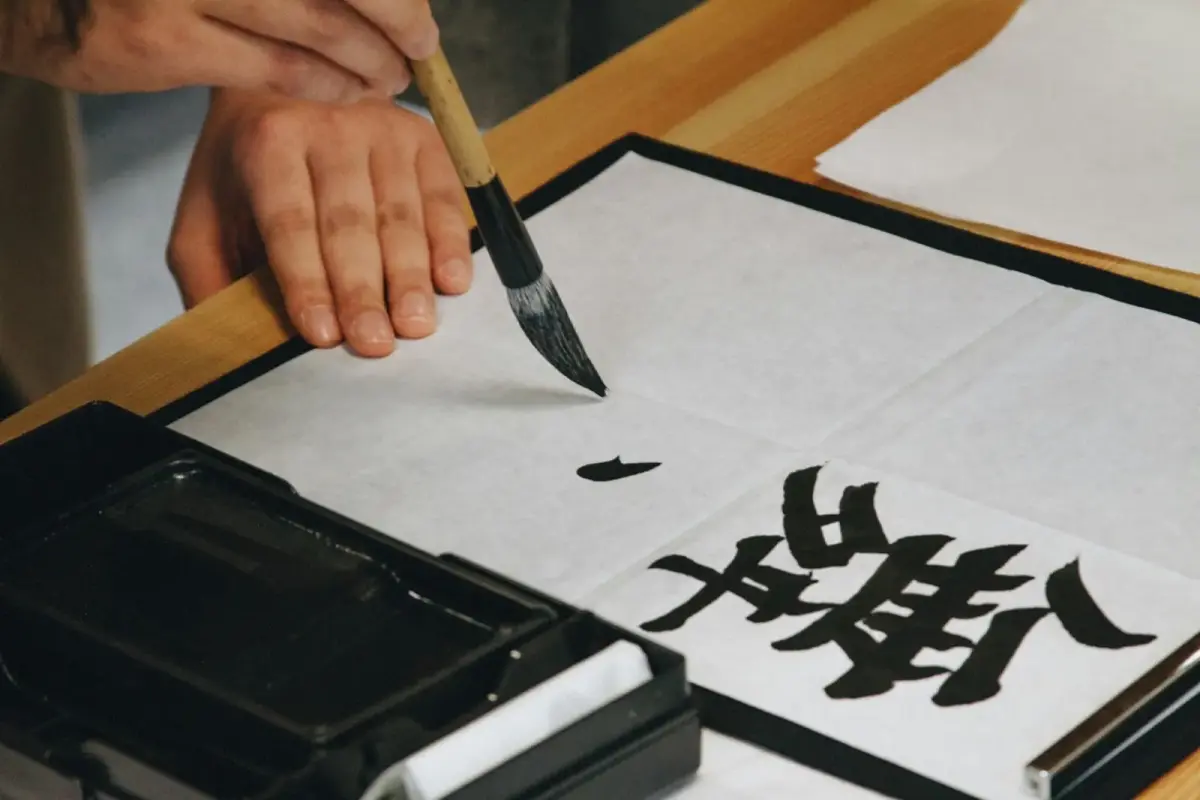
To an observer, a calligrapher may appear to be doing nothing. The brush rests quietly above the paper, and several moments pass before the first stroke is made.
In reality, the work has already begun.
The calligrapher settles into the right posture, steadies their breathing, calms the body, and only then lifts the brush. In the Chinese tradition, a line is believed to begin not in the hand, but in the mind. The brush simply gives visible form to what has already taken shape within.
Before the brush ever touches the paper, the entire work already exists as an intention. Every stroke that follows is simply its unfolding.
A Brushstroke Can Never Be Taken Back
The moment the brush meets the paper, there is no turning back.
Ink quickly sinks into rice paper or silk. It cannot be erased, painted over, or rewritten. Every hesitation, every burst of confidence, every tiny imperfection becomes a permanent part of the work.
For that reason, students rarely begin by writing beautiful texts. They spend years practising simple lines, learning to control pressure, maintain rhythm, and guide the brush with precision before attempting complete characters.
Every finished character carries the memory of countless irreversible movements.
Why the Same Sentence Can Be Written in Hundreds of Different Ways
At first glance, it might seem that the goal of calligraphy is simply to write a character correctly.
But a correctly written character is only the beginning.
The very same sentence can appear formal and restrained, flowing and elegant, or energetic enough to suggest that the brush was racing to keep up with the writer’s thoughts. Different calligraphic styles range from ancient, carefully structured scripts to highly cursive forms in which individual strokes merge into a single continuous movement.
An experienced viewer does not see words alone. They notice rhythm, confidence, restraint, emotion, and the unmistakable personality of the person holding the brush.
That is why the finest works of Chinese calligraphy are appreciated as paintings rather than merely as writing.
Why This Tradition Could Only Have Emerged in China
Chinese calligraphy is inseparable from the Chinese writing system.
A Chinese character is not built from a handful of letters but from carefully ordered strokes, each with its own direction, length, sequence, and pressure. Even a subtle change in the way a stroke is written can completely alter the visual character of the work while leaving its meaning unchanged.
Over time, writing became far more than a practical way to communicate. It evolved into a form of artistic expression in which every character became a carefully balanced composition.
This is how calligraphy came to stand alongside painting, poetry, and ink art as one of China’s highest artistic traditions.
Where to Experience Chinese Calligraphy Today
Chinese calligraphy is anything but a forgotten tradition.
Original masterpieces can be seen in museums, classical art exhibitions, and historic gardens throughout China. In many cultural sites, skilled calligraphers still create scrolls by hand for visitors.
Perhaps the most memorable place to encounter the tradition, however, is an ordinary city park early in the morning. Elderly residents arrive carrying long-handled brushes and write enormous Chinese characters directly onto stone paths using nothing but water. Within minutes, the writing evaporates, leaving the pavement exactly as it was before.
There is something deeply beautiful about this practice. The work is created not to last forever, but simply for the act of creating it.
Why UNESCO Protects the Art of Writing, Not the Characters Themselves
UNESCO did not recognize the Chinese writing system. Nor did it recognize the characters themselves.
What it chose to protect is an artistic tradition that brings together centuries of knowledge, discipline, technical mastery, and the ability to express oneself through only a few carefully placed brushstrokes.
In a world where most people type far more often than they write by hand, Chinese calligraphy reminds us that writing can be much more than a way to record ideas.
Sometimes, the act of writing becomes the work of art itself.