Best time to go: Spring & autumn concerts. Court music built for an empire, gagaku moves so slowly that the first challenge isn't understanding it — it's learning to stop waiting for it to start.
At First, It Feels Like the Music Hasn’t Started Yet
Imagine taking your seat in a concert hall. The lights slowly fade, the musicians are already in place, and you expect the first chord to arrive at any moment. Instead, a single sustained note emerges from what feels like empty space. A few seconds later, another sound answers it. Then comes a pause so long that you almost want to glance around the room to make sure the performance has actually begun.
This is how most people encounter gagaku, the ancient court music of Japan, for the first time. Rather than immediate admiration, it often inspires confusion because almost everything about it contradicts what modern listeners expect from music.
We are used to music telling us how to feel almost instantly. It quickly establishes a rhythm, builds toward a chorus, increases tension, or makes our bodies move with the beat. Even the calmest contemporary compositions usually try to hold our attention by constantly introducing something new.
Gagaku follows a completely different path. It never rushes to impress the listener or prove its beauty within the opening moments. Instead, it quietly asks whether you are willing to let go of your habit of constantly waiting for the next event.
That is why many people initially believe that almost nothing is happening. Only after a few minutes do they realise that many things are changing. The changes simply unfold so slowly that they cannot be noticed in the usual way.
Perhaps this is where the real encounter with gagaku begins. It starts not with the first note, but with the moment you stop waiting for the music to speed up.
Music That Lives in a Different Sense of Time
When people describe gagaku as one of the world’s oldest surviving musical traditions, it is easy to picture a museum piece. Its slow pace can seem like nothing more than a relic of the distant past, as if life itself simply moved more slowly a thousand years ago.
The reality is quite different. Gagaku was never created to entertain an audience or accompany everyday life. It existed alongside court ceremonies and gave those ceremonies their own distinct flow of time.
Imagine a state reception or an imperial ritual where every movement has been carefully prescribed. No one is in a hurry because speed has no value in such a setting. What matters instead is precision, order, and the dignity of every gesture. Gagaku was created for exactly that world.
The music does not push events forward. It creates no feeling that something even more exciting is about to happen. Instead, it stretches the present moment and allows it to exist longer than we normally expect.
This way of experiencing time feels unfamiliar, especially to modern listeners. Our lives are filled with notifications, short videos, background music, advertisements, and an endless stream of new impressions. Our attention constantly jumps from one thing to another, making anticipation feel like a permanent state of mind.
Gagaku slowly takes that habit away. At first, you keep wondering when the music will finally develop. Then you begin asking yourself why the musicians are playing so slowly. A few minutes later, the question quietly disappears on its own.
At that moment, the music itself is no longer the main focus. The passing of time becomes the real subject.
Why the Imperial Court Sounded Like This
To understand gagaku, it helps to forget the word concert. For most of its history, this music belonged to a completely different world.
It accompanied life at the Imperial Court, state ceremonies, official banquets, and formal court dances. The music formed one part of a much larger ritual rather than serving as a performance that people attended simply to listen.
Because of that, its purpose was very different from the purpose of music today. It was never expected to surprise, entertain, or constantly capture the audience’s attention. Doing so would have distracted from the ceremony itself, and the ceremony was always more important than the music.
In many ways, gagaku creates not a mood but a space. It separates the event from ordinary life and reminds everyone present that they have entered a different kind of world, one that follows its own rhythm and demands its own sense of attention.
The same idea appears in bugaku, the ceremonial court dances traditionally performed alongside gagaku. The dancers move slowly and deliberately, never trying to impress through speed or technical brilliance. Music and movement exist together, gradually strengthening the feeling of dignity and solemnity.
That is why the slow pace of gagaku was never considered a weakness. It belonged to a courtly culture that valued order, composure, and inner concentration far more than speed or dramatic expression.
When modern audiences hear this music for the first time, it often seems to contradict everything they believe music should do. In reality, it simply reminds us that art has not always tried to capture human attention at any cost.
What Space Sounds Like
If you close your eyes during a performance of gagaku, it does not take long before you stop hearing individual instruments. Instead, it feels as though sounds are appearing from different parts of a vast space, slowly moving toward one another.
This is one of the defining qualities of the ensemble. Each instrument has its own role, yet together they create not a dense musical texture but the impression of a large volume of air where sounds gradually appear and disappear.
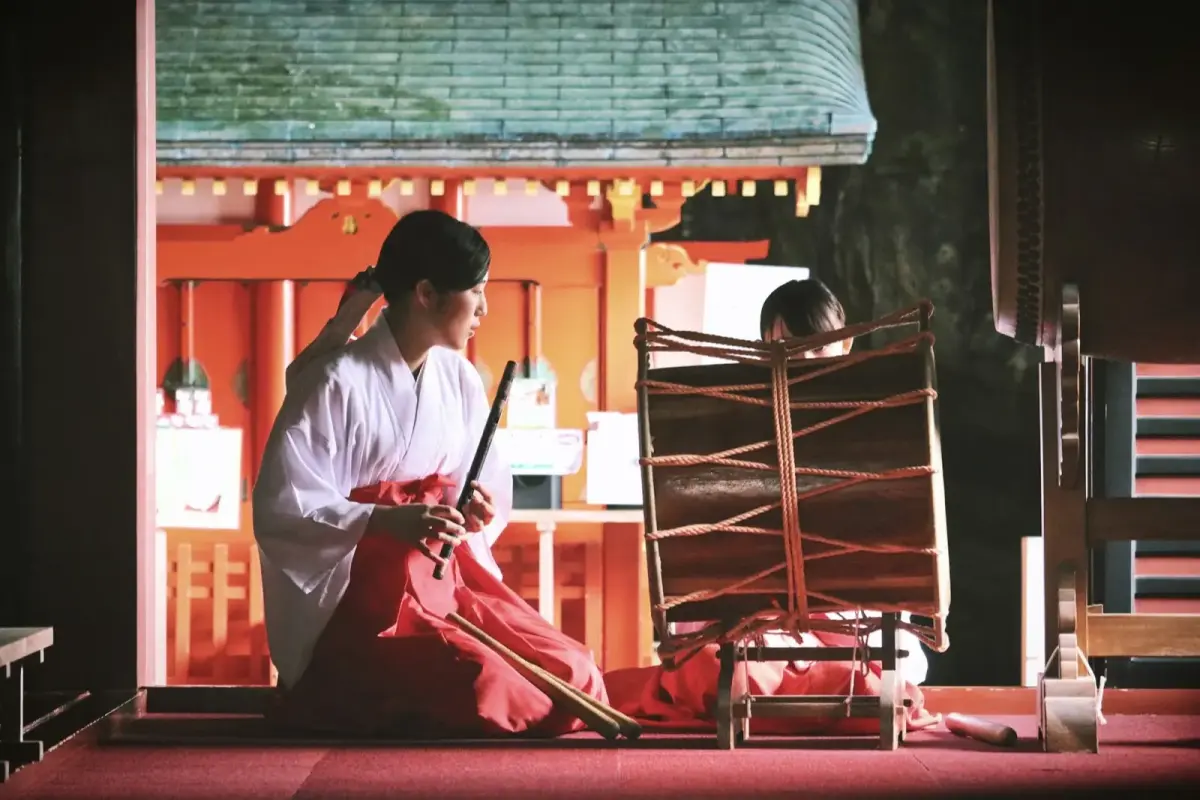
One of the most distinctive voices belongs to the shō, a small mouth organ made of slender bamboo pipes. Rather than carrying the melody in the usual sense, it sustains long clusters of notes that make the entire musical space seem quietly illuminated.
Against that background comes the hichiriki, a tiny double-reed instrument with an unexpectedly powerful voice. Its sound is not especially soft or gentle. Many first-time listeners even find it surprisingly sharp, yet it carries one of the ensemble’s principal melodic lines.
Above them floats the ryūteki, a transverse bamboo flute. Instead of dominating the other instruments, it seems to glide over them, adding a sense of movement within music that otherwise feels almost motionless.
The percussion works differently as well. It does not create a steady pulse that invites people to tap their feet. Its occasional strikes act more like landmarks in time, subtly changing the way everything around them is perceived.
That is why many listeners eventually stop noticing silence itself and begin noticing space. The sounds are not competing for attention. Each one is allowed enough time to appear fully, change gradually, and disappear naturally.
Perhaps that is why, after only a few minutes, you stop counting the pauses. Instead, you begin listening to the air between the sounds, even though only moments earlier the music had seemed impossibly slow.What Happens to the Listener
One of the most remarkable things about gagaku is that, after a while, you stop thinking about the music itself. Without noticing, your attention shifts away from melodies, rhythms, and individual instruments. Instead, you begin paying attention to your own way of listening.
At first, the mind keeps searching for familiar patterns. You expect the melody to build, the tempo to increase, or a dramatic moment to arrive. When none of those things happen, you become aware of something unexpected. It is not the music that feels impatient. It is you.
Modern life trains us to expect constant stimulation. Every spare moment is filled with music, conversations, notifications, or something happening on a screen. Silence often feels like empty space that needs to be filled as quickly as possible.
Gagaku quietly challenges that habit. It never asks you to concentrate harder or analyse what you hear. Instead, it slows the pace of your attention until listening itself becomes a different experience.
Eventually, you stop measuring the music by the number of events taking place. A single sustained note becomes interesting because of how it changes over time. A pause no longer feels like an interruption. It becomes part of the music’s natural flow.
This is why people often describe their first encounter with gagaku as strangely calming, even if they did not particularly enjoy the music itself. The experience is not always about discovering a new favourite style. Sometimes it is simply about discovering a different way of paying attention.
Where You Can Hear Gagaku Today
Although gagaku has been closely associated with the Imperial Court for more than a thousand years, it is not hidden away from the public. Travelers who plan ahead still have opportunities to hear it performed in settings that reflect its original character.
One of the best-known opportunities is the series of public performances given by the Music Department of the Imperial Household Agency in Tokyo. These concerts are traditionally held in spring and autumn, allowing visitors to hear the music performed by musicians who continue the court tradition today.
Kyoto also hosts occasional performances connected with the former Imperial Palace and special cultural events. Unlike regular theatre productions, these performances are not available every day, so they are worth checking before planning a trip.
Gagaku can also be heard in concert halls, at traditional festivals, and during certain Shinto ceremonies or temple events across Japan. These settings naturally differ from the Imperial Court, yet they still offer an opportunity to experience the music as a living tradition rather than a museum exhibit.
Unlike many traditional performances that travelers encounter by chance, gagaku is something worth planning around. If hearing it is one of the reasons for visiting Japan, checking concert schedules in advance will greatly increase your chances of experiencing it in the right setting.
What May Surprise or Disappoint You
Many people imagine ancient court music as something soft, gentle, and immediately relaxing. Gagaku often turns out to be very different.
The hichiriki, one of the ensemble’s main melodic instruments, has a powerful, penetrating tone that some listeners even describe as harsh. The music can also feel surprisingly static, especially during the first few minutes, when changes seem almost imperceptible.
It is also important not to expect a meditative soundtrack designed for relaxation. Although gagaku moves slowly, it was never created for mindfulness sessions or quiet background listening. It was written for ceremonies that expressed dignity, authority, and order.
For some listeners, the experience remains distant from beginning to end. Others suddenly realise that they have stopped waiting for the next musical event and have simply accepted the pace of the performance. That moment often determines whether gagaku feels frustrating or deeply rewarding.
The best approach is surprisingly simple. Do not wait for a dramatic climax. Listen to how a single sound appears, slowly changes its colour, and quietly gives way to the next one.
What UNESCO Actually Recognised
In 2009, UNESCO added gagaku to the Representative List of the Intangible Cultural Heritage of Humanity. The recognition was not given to a single composition or to the Imperial Court orchestra alone.
Instead, UNESCO recognised an entire living tradition that combines instrumental music, ceremonial dances, songs, performance techniques, and the knowledge passed from experienced musicians to younger generations. The organisation also highlighted the remarkable way in which musical traditions from different parts of Asia gradually came together in Japan to form something entirely new.
That perspective makes gagaku even more fascinating. Rather than preserving a single frozen moment from history, it demonstrates how traditions can absorb outside influences, evolve over centuries, and still remain recognisably themselves.
When the Music Ends
Eventually, the final note fades away. Nothing dramatic happens after that. There is no triumphant ending, no sudden burst of applause built into the music itself, and no feeling that everything has been leading toward one overwhelming conclusion.
Instead, there is simply silence.
For a brief moment, however, that silence feels different from the silence that existed before the performance began. It no longer seems empty. It feels as though the music has changed the way you hear the space around you.
Perhaps that is why gagaku has survived for more than a thousand years. It reminds us that not every experience has to become faster, louder, or more intense in order to matter.
Some experiences become meaningful for exactly the opposite reason. They invite us to stop chasing what comes next and notice what has been here all along.