Best time to go: Year-round, theatres nationwide. Two performers, a fan and a drum: pansori builds palaces, rivers and entire dynasties out of nothing but a voice and an audience's imagination.
Imagine a Stage That Is Almost Empty
Before a performance begins, your eyes instinctively search for familiar signs. You expect elaborate scenery, a curtain, an orchestra in the pit, or at least a group of actors about to bring a story to life.
But none of that is there.
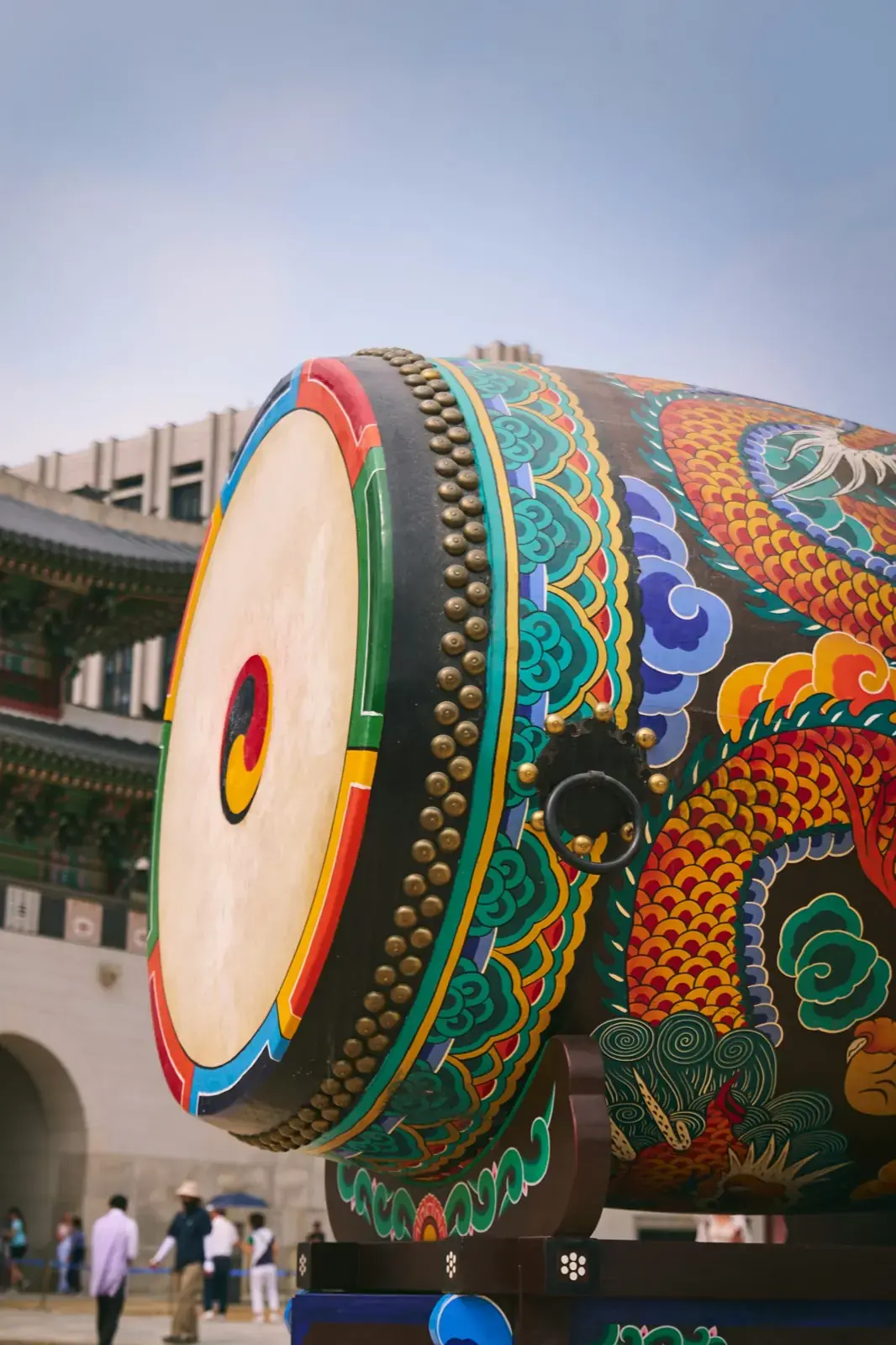
One person sits on the stage holding a fan. A short distance away, another sits behind a drum. There is so much empty space between them that it feels as though the rest of the performers simply have not appeared yet.
If you have never seen pansori before, your first thought might be surprisingly simple. This is one of Korea’s greatest cultural treasures? This is the art form that UNESCO has chosen to recognize?
A few seconds pass.
The singer takes the first breath. The drummer answers with a single beat. Almost without realizing it, you stop thinking about what the stage is missing. Instead, you begin to see things that were never there in the first place.
That is the moment when pansori truly begins.
The tradition is centuries old, yet its basic principle has barely changed. Two people create an entire world using nothing more than a voice, a drum, a fan, and the audience’s imagination. Everything else comes into existence while the performance unfolds.
Perhaps that is why pansori rarely looks impressive in photographs. A single image captures only two performers standing on an almost empty stage. The real magic happens somewhere a camera cannot reach. It happens inside the mind of the audience.
After a Few Minutes, You Forget There Are Only Two People on Stage
In Western theatre, every character usually belongs to a different actor. One plays the king, another the servant, another the narrator. When a new character appears, another performer simply walks onto the stage.
Pansori follows an entirely different set of rules.
Here, one performer becomes everyone.
Only moments ago, the singer was calmly narrating the story. In the next sentence, that same person becomes a young woman. A heartbeat later, the voice drops lower, the posture changes, and her enemy suddenly stands before you. Then, almost instantly, the narrator returns, as though nothing unusual has happened.
There are no costume changes.
The performer never disappears behind the curtain. Every transformation happens in full view of the audience through subtle changes in voice, facial expression, rhythm, and body language.
After a while, you stop analysing these transitions. Your mind quietly accepts the new rules of the performance and begins filling in the missing pieces on its own.
You no longer see a person holding a fan.
You see an elderly government official.
A moment later, you see a frightened young woman.
Then a cunning merchant.
Then the narrator once again, weaving every scene back into a single story.
That is why the fan in the performer’s hand becomes something close to magic.
One moment it represents a letter that has just arrived. A little later it becomes a door, an oar, a sword, a winding road, or simply an extension of a gesture. The performer rarely imitates objects literally. Instead, a small hint is offered, and the audience completes the picture.
The experience feels remarkably similar to reading an excellent novel.
A great writer does not describe every detail. A few carefully chosen words are enough for the reader to imagine a house, a forest, a face, or an entire city. Pansori works in much the same way, except that the storyteller is standing in front of you rather than speaking from the pages of a book.
That makes every performance deeply personal.
The scenery that appears in your imagination will never be exactly the same as the scenery imagined by the person sitting beside you. Both of you are watching the same performance, yet each creates a different world.
Perhaps that is why the empty stage soon stops feeling empty. The longer the performance continues, the less you notice the absence of scenery, costumes, or elaborate stage effects.
Eventually, a curious feeling appears.
You realise that you have been seeing palaces, mountains, rivers, houses, and entire cities all along, even though only two people have been standing on the stage.
Why Nobody Is Trying to Sing Beautifully
When people attend the opera for the first time, they often judge the beauty of the voice. They expect flawless high notes, perfectly controlled breathing, and an elegant, polished sound.
Pansori asks you to listen differently.
For many first-time visitors, the voice comes as a surprise. It may sound raw, powerful, rough, or almost strained. At times, it can even seem as though the singer is pushing the voice to its absolute limit, although this is often exactly the sound the performer has spent years learning to achieve.
In pansori, beauty is not measured by smoothness.
What matters far more is whether the voice can express fear, exhaustion, joy, grief, laughter, and countless other emotions carried by the story. The goal is not simply to sing beautifully. The goal is to hold an audience’s attention for hours.
A complete traditional performance can last for most of the day. Throughout that entire time, the singer remains almost solely responsible for keeping an entire imaginary world alive. If the voice stops convincing the audience, the performance itself begins to disappear.
That is why becoming a pansori master takes so many years.
Students learn far more than melodies. They learn how to tell stories, how to move, how to transform into different characters within a single breath, how to control their breathing, and eventually how to develop a style that belongs to no one else. Even when two masters perform exactly the same story, experienced listeners can recognise them immediately.
One of the most famous stories about pansori training comes from this tradition.
According to old accounts, students once retreated into the mountains to practise beside waterfalls. To make their voices carry above the roar of rushing water, they had to pour extraordinary power into every phrase. These stories are rooted in genuine historical traditions, although over time many legends have grown around them.
Some tales even describe singers pushing themselves until they lost their voices or began coughing blood. Such stories have become part of the romantic mythology surrounding the great masters of the past, but modern teachers approach them with much greater caution. Today, vocal health is considered just as important as vocal power, and training methods have become far more sustainable.
Perhaps that is why pansori should never be judged during the first few minutes.
If you expect the polished sound of Western classical singing, you may feel something is missing. Gradually, however, another understanding begins to emerge. This voice was never meant to sound perfect.
It was meant to convince you that an empty stage is filled with people who were never actually there.
There Are Not Two People on Stage. There Are Three.
At first, it seems as though the performance belongs entirely to the singer. The drummer appears to sit quietly at the side, adding only an occasional beat and fading into the background.
That impression lasts only until you begin paying attention.
The drummer is not there to keep time like a metronome. Every strike is a response to the story unfolding in front of him. He listens to every phrase, senses every pause, and answers with rhythms that encourage, challenge, or intensify the singer’s performance.
The relationship between the two performers resembles a conversation more than accompaniment.
Sometimes the drum pushes the story forward. At other moments it deliberately holds back, leaving the voice to carry the emotional weight alone. Then, with a single beat, the tension returns, almost as though another invisible character has entered the scene.
The drummer also becomes the first audience member.
During the performance, he occasionally calls out short words of encouragement. These are not interruptions or spontaneous reactions. They are an essential part of the tradition, acknowledging moments when the singer has expressed an emotion particularly well or reached an especially dramatic point in the story.
Then something even more unexpected happens.
People in the audience begin calling out as well.
If you have never experienced pansori before, the first shout can be startling. In many theatres around the world, speaking during a performance would be considered deeply disrespectful. Here, silence is not always the highest form of appreciation.
These encouraging exclamations are known as chuimsae.
Experienced listeners know exactly when to respond. They may shout a brief expression of approval, encouragement, or admiration, adding energy to the performance without disrupting it. The singer hears these voices, responds to their enthusiasm, and often performs with even greater intensity.
The result is unlike almost any other theatrical tradition.
Instead of a strict line separating performers from spectators, the performance becomes a shared experience. The singer tells the story. The drummer supports it. The audience breathes life into both.
Only then do you realise that there were never two people creating this imaginary world.
There were always three.
Why People Return to Hear a Story They Already Know
Most modern audiences expect suspense.
We buy a novel because we want to discover how it ends. We watch a film because we do not know what will happen next. Once we know the ending, many stories lose part of their appeal.
Pansori grew from a completely different way of listening.
Traditionally, audiences already knew the stories long before they entered the performance. The famous tales had been passed from generation to generation, and many listeners could have retold every major event themselves.
Yet they still came back.
They returned because they were not waiting for the ending. They were waiting for this performer.
Imagine attending two concerts where different pianists play exactly the same piece by Chopin. The notes remain identical, but the experience feels completely different. One performer may reveal tenderness, another excitement, another quiet sorrow.
Pansori follows the same principle, but with stories instead of musical scores.
Each master develops a personal way of shaping a familiar narrative. A pause may become longer. A joke may become funnier. A tragic scene may feel even more devastating because of a single change in timing or tone.
The audience does not ask, “What happens next?”
Instead, they wonder, “How will this singer tell it today?”
That difference changes everything.
Among the surviving traditional repertoires, one of the best known is Chunhyangga, the story of the faithful Chunhyang and her determination to remain loyal despite overwhelming pressure. Another favourite is Sugungga, a fantastical tale in which a turtle attempts to trick a rabbit into surrendering its liver for the Dragon King’s cure.
The plots themselves are not the main attraction.
The real performance takes place in the space between the familiar story and the individual artist’s imagination. Every generation inherits the same narrative, but every great performer finds a slightly different way to make it feel alive again.
Perhaps that is why pansori has survived for centuries.
The stories remained recognisable enough to be shared by everyone, yet flexible enough for each master to leave a personal mark upon them.
What May Surprise You — And What May Disappoint You
Pansori is not a performance that tries to please everyone immediately.
Some visitors fall in love with it within minutes. Others spend half the performance wondering whether they are missing something important. Both reactions are completely understandable.
The voice is often the first obstacle.
Anyone expecting the polished elegance of Western opera may initially find the sound unusually rough or forceful. That reaction is common, especially among first-time listeners who have never encountered this vocal tradition before.
The language can be another challenge.
Much of pansori’s humour, wordplay, and emotional subtlety lives inside the Korean language itself. Even when subtitles are available, some layers inevitably remain beyond the reach of translation.
The length of traditional performances surprises many people as well.
A complete rendition can continue for several hours, sometimes for most of the day. That remarkable endurance is one of the tradition’s defining qualities, but it also demands patience from modern audiences who are accustomed to much shorter performances.
Fortunately, first-time visitors are not expected to begin with the full experience.
Many theatres present selected scenes or shorter programmes that introduce the style without requiring an entire day. These performances offer an excellent way to understand the essence of pansori before deciding whether to experience one of the great complete epics.
One final distinction is worth remembering.
You may also encounter changgeuk, a modern theatrical form that developed from pansori. Changgeuk uses multiple actors, elaborate costumes, scenery, and stage production. It can be beautiful in its own right, but it creates a very different experience.
If pansori asks your imagination to build an entire world, changgeuk places much of that world directly in front of your eyes.
Neither approach is better.
They simply invite you to experience the same stories in two completely different ways.
Where to Experience Pansori Today
For many visitors to Korea, the hardest part is not deciding whether to see pansori. It is deciding where to begin.
The answer depends on the experience you are looking for. Some performances are designed for devoted enthusiasts willing to spend an entire day with a single epic. Others offer shorter introductions that make the tradition far more approachable for first-time audiences.
If you are visiting Seoul, the National Theater of Korea is one of the best places to start.
Its performances are professionally staged, carefully curated, and often include productions by some of the country’s leading singers. Throughout the year, the theatre presents both complete traditional epics and shorter programmes, making it possible to choose an experience that matches your level of curiosity.
Jeonju offers something rather different.
The city is closely connected with the historical development of pansori and remains one of its cultural homes. Listening to the tradition here feels less like attending a formal performance and more like encountering a living part of the region’s identity. Festivals, outdoor stages, and cultural events regularly feature pansori alongside other forms of traditional Korean music.
Another important destination is Namwon.
The city is deeply associated with Chunhyangga, one of the most beloved pansori stories. Visitors interested in exploring the tradition beyond a single performance will also find museums, cultural centres, and educational programmes dedicated to preserving this remarkable art form.
Wherever you choose to go, one piece of advice remains the same.
Do not feel obliged to begin with a full eight-hour performance. A carefully selected programme of individual scenes is often a better introduction. Once you understand the language of pansori, returning for a complete epic becomes a much more rewarding experience.
What UNESCO Actually Chose to Protect
When people hear that pansori is recognised by UNESCO, they often imagine that a handful of famous songs have been placed on an international list.
The reality is much more interesting.
UNESCO did not recognise a single performance, a famous singer, or even a specific collection of stories. Instead, it recognised an entire way of telling stories through music, voice, rhythm, gesture, memory, and human imagination.
That distinction matters.
If every singer performed exactly the same version in exactly the same way, pansori would become little more than a historical reconstruction. The tradition survives because each generation learns from those who came before while still developing a voice of its own.
Protecting a living tradition is very different from protecting an ancient building.
A palace can remain unchanged for centuries. A performance cannot. Every time a singer steps onto the stage, the tradition is recreated all over again. The stories remain familiar, but every performance becomes unique because no two artists breathe, pause, or speak in exactly the same way.
That balance between preservation and change has become one of the greatest challenges facing pansori today.
Modern documentation has helped safeguard the repertoire for future generations. At the same time, fixing texts too rigidly on the written page inevitably leaves less room for the spontaneous improvisation that once flourished within the tradition.
Perhaps that is why UNESCO chose to protect not simply the stories themselves, but the relationship between teacher and student, performer and audience, memory and imagination.
Without those human connections, the words alone would never be enough.
When the Performance Ends
As the final drumbeat fades away, the stage looks almost exactly as it did at the beginning.
Two performers remain where they have always been. The fan is still resting in one pair of hands. The drum is still standing beside the other. Nothing physical has changed.
And yet something has changed completely.
Somewhere during the performance, you stopped noticing the empty stage. You stopped searching for scenery, costumes, and elaborate stage machinery. Without realising it, you accepted the invitation to create part of the performance yourself.
That may be the greatest achievement of pansori.
It quietly reminds us that the most powerful theatre has never depended on painted backdrops or expensive technology. Long before electricity, microphones, or digital projections existed, people already knew how to build entire worlds using nothing more than a human voice and another person’s imagination.
Perhaps that is why pansori continues to feel surprisingly modern.
We live in an age surrounded by spectacular visual effects. Films, concerts, and digital media constantly compete to show us something larger, brighter, and more realistic than before. Pansori takes the opposite path. It removes almost everything until only the essentials remain.
Then it asks a simple question.
How much can two people create if they trust the imagination of everyone listening?
After spending an evening with pansori, the answer feels unexpectedly clear.
Far more than an empty stage should ever be able to hold.