Best time to go: Workshops & museums, year-round. A single lacquer box can carry half a year of invisible labour beneath a few millimetres of perfect surface.
Why One Lacquer Box Can Take Half a Year to Make
At first glance, it is difficult to imagine that a small lacquer box can contain half a year of someone’s life. It is compact, its surface is perfectly smooth, and the decoration may consist of only a few delicate lines. It seems as though the artisan simply took a wooden box, covered it with black lacquer, added a touch of gold, and finished the job.
But lacquerware follows a very different logic. It is almost impossible to make quickly because its most important material demands patience more than skill. It refuses to move on to the next stage until the previous one is complete. The artisan can control the brush, the thickness of each coat and the design—but not time itself.
A Material That Begins with a Tree
Traditional East Asian lacquer comes from the sap of the lacquer tree. To collect it, shallow cuts are made in the bark and the sap is gathered little by little. Freshly collected, it is milky white, but it gradually darkens when exposed to the air.
The sap is then refined and prepared for different stages of production. One mixture strengthens the foundation, another is used for intermediate coats, and another becomes the final finish or decorative layer. The word lacquer therefore describes not a single substance but an entire family of carefully prepared materials, each with its own role.
Wood is the most common base, but lacquer can also be applied to bamboo, fabric, paper, leather, metal, ceramics and other materials. What began as a practical way to protect surfaces from moisture and damage eventually evolved into an art form in its own right.
Lacquer stopped being merely a protective coating. It became a material capable of creating depth, colour and relief.
Why Lacquer Does Not Simply Dry
Ordinary paint dries because its liquid evaporates. Natural lacquer behaves differently. It hardens through a chemical reaction that depends on moisture in the air.
For this reason, a freshly lacquered object is placed inside a special cabinet or chamber where temperature and humidity are carefully controlled. Dry air does not speed up the process—it can actually prevent the lacquer from curing properly. Traditional Japanese urushi, for example, usually requires a warm, humid environment of around 25°C (77°F) and roughly 70% relative humidity.
It is one of those details that completely changes the way you think about the craft. Instead of leaving the object in the sun or near a fire, artisans place it in a dark, humid space—and wait.
One Coat Changes Almost Nothing
The first layer does not yet resemble a finished object. Its only purpose may be to strengthen the wooden core or prepare the surface for everything that follows.
Once the lacquer has cured, the surface is polished. Another coat is applied, left to cure, then polished again. The same rhythm repeats over and over: apply, wait, inspect, polish, begin again.
The number of stages depends on both the technique and the purpose of the object. An everyday bowl follows a very different path from a ceremonial lacquer box. It would therefore be misleading to say that every lacquered object contains hundreds of layers. Yet in the most sophisticated traditions, a single piece may indeed require dozens of coats and well over a hundred individual operations.
Each layer is so thin that an entire day’s work may produce almost no visible change. Yet these barely noticeable differences gradually create a surface that could never be achieved with one thick application.
Why Everything Cannot Be Applied at Once
If a layer is applied too thickly, it may cure unevenly, wrinkle or obscure the shape of the object beneath. Instead of creating depth, it produces a heavy, lifeless surface.
Thin coats allow the lacquer to become part of the object little by little. The lower layers strengthen the foundation, the middle layers refine it, and the upper layers create colour and lustre. During polishing, brush marks and tiny imperfections disappear—but so does part of the lacquer itself.
The artisan is therefore not simply adding material. After every application, some of it is removed again. Progress is almost invisible because perfection comes from repeatedly applying and carefully taking away.
More Than One Artisan May Create a Single Object
A lacquer box is not always made by a single person from beginning to end. In established craft centres, different specialists are often responsible for different stages.
One prepares the wood. Another builds the foundation and ground layers. A third applies the lacquer, while someone else polishes the surface. Finally, a specialist in decoration adds painting, carving or metallic powder.
The time required to complete an object therefore consists of much more than hours of manual labour. The piece moves from workshop to workshop, curing between each stage before it can continue. Even when one artisan has finished their work, the next cannot begin until the lacquer is ready.
The object travels from one pair of hands to another far more slowly than a modern product moves along a factory line. Yet this slow journey preserves the knowledge of several different crafts within a single piece.
When the Design Lives Beneath the Surface
In ordinary painting, the image sits on top of the finished object. In lacquer art, decoration often becomes part of the surface itself.
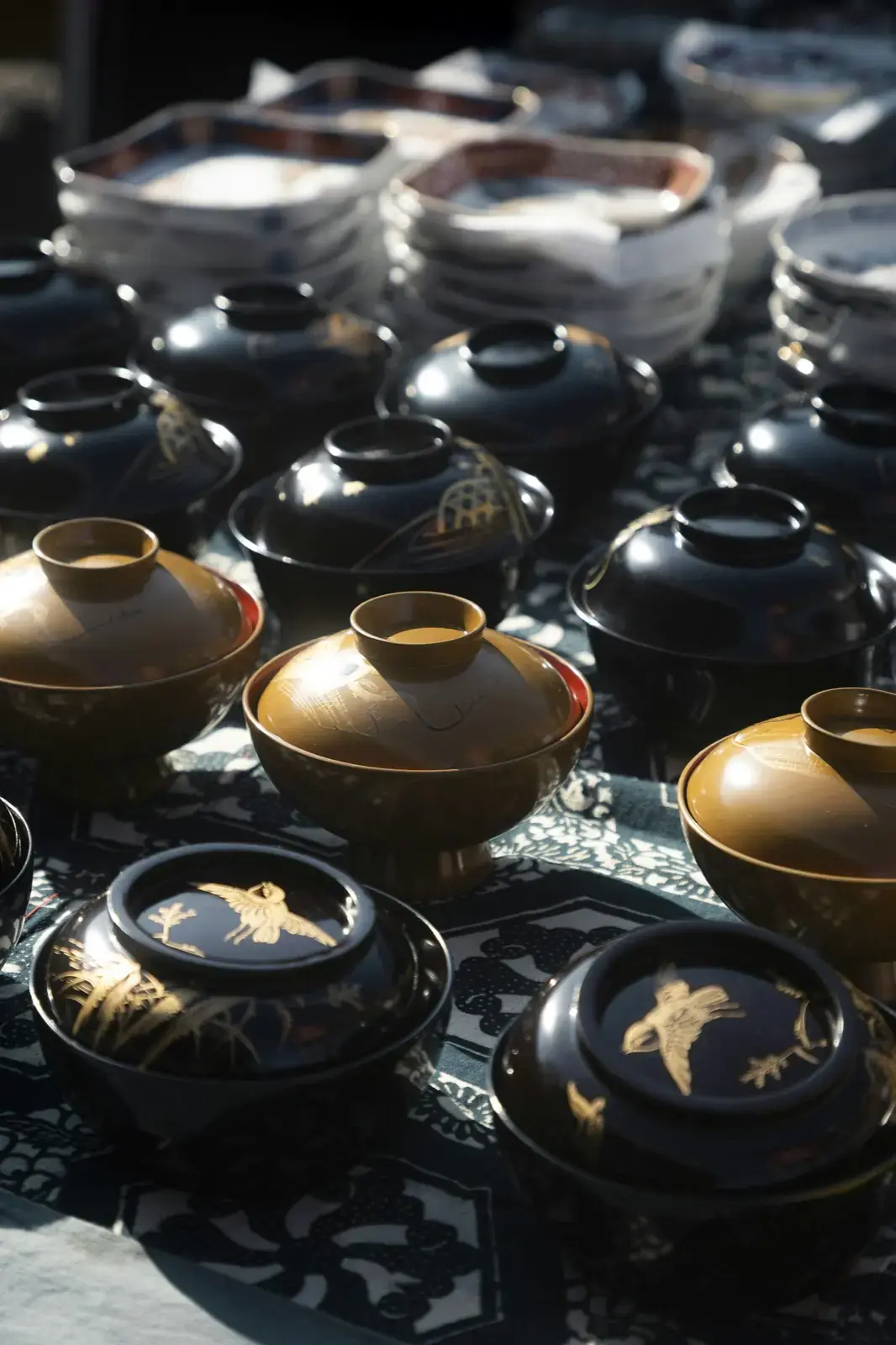
In the maki-e technique, the design is created using metallic powder, usually gold or silver. The powder is sprinkled onto wet lacquer, sealed beneath additional layers and polished until it appears to glow from within rather than rest on the surface.
Other techniques involve carving into the lacquer, engraving its surface or building patterns from multiple coloured layers. An artisan may apply one colour over another before gradually removing the upper layers to reveal the intended design beneath.
The result is an unusual illusion. The image seems to exist both inside and outside the object at the same time. It cannot be separated from the surface because it was created together with it.
Mistakes Reveal Themselves Too Late
In such a slow craft, even the smallest mistake can be expensive. A speck of dust, an uneven brushstroke or a polishing error may not become visible until the lacquer has fully cured.
Sometimes the defect can be corrected through further polishing. Sometimes several stages must be repeated. If too much of a decorative layer is removed, however, the original surface may be impossible to restore.
That is why months of work are not spent decorating an object. Much of the time is devoted to preparation, waiting and creating the conditions in which nothing should go wrong.
The artisan is working not only with materials, but also with the possibility of failure.
Why a Lacquer Object Does Not Reach Its Beauty Immediately
A finished object continues to change long after it leaves the workshop. Natural lacquer may gradually become more transparent, allowing the colours and decorative elements beneath the surface to emerge more clearly.
The surface also responds to use. A bowl handled regularly develops a softer sheen over time. It does not necessarily remain exactly as it looked on the day it was purchased, but these changes are not considered damage.
For lacquerware, time does not end when the object is finished. The first months create its structure. The years that follow shape its character.
Why This Craft Is Difficult to Preserve
The greatest threat to lacquer art is not that old boxes might disappear from museums. It is that fewer people possess the knowledge needed to prepare the materials, judge the correct thickness of each coat and recognise the precise moment when the lacquer is ready for polishing.
These skills cannot be fully captured in written instructions. They are learned by watching how the material reflects light, how the brush moves across the surface, how humidity affects curing and how the lacquer feels beneath the hand.
This is why UNESCO views traditional craftsmanship primarily as knowledge and skills passed from one generation to the next. Preserving the craft means protecting not only the objects themselves, but also the conditions that allow new ones to continue being made.
There is no single UNESCO Intangible Cultural Heritage element that brings together all lacquer traditions of China, Japan, Korea and Myanmar. UNESCO has supported international initiatives dedicated to East Asian lacquer traditions, but each country’s practices are recognised and safeguarded through their own cultural heritage systems.
After learning how lacquerware is made, it becomes difficult to look at a lacquer box as just another museum object. You begin to want to see not only the finished piece, but the moment another almost invisible layer is brushed onto its surface, the gold disappears beneath a transparent coat, and the artisan quietly sets it aside for days before touching it again. In Japan and China, this tradition has been preserved in different ways: in some places you can step inside working workshops where the craft is still alive, while in others you can follow its story through museum collections that preserve thousands of years of lacquer art.
Six Months Hidden Beneath the Surface
When you look at a finished lacquer box, there is no way to count its layers. You cannot tell how many days it spent inside a dark, humid cabinet, how many times it was polished or how many artisans passed it from one workshop to another.
The surface keeps no calendar.
That is the essence of lacquer art. Six months of work do not become a larger object or a more complicated mechanism. They disappear into just a few millimetres of an almost perfect surface.
A lacquer box looks simple only until you discover how much time it took to make that simplicity possible.
Where to See Lacquerware Being Made
Lacquerware can be found in museums throughout Asia. But to understand why a single box or bowl may take months to complete, it is worth looking beyond finished objects and seeking out the places where artisans still practise the craft today.
Some destinations are better for encountering lacquerware as a living tradition, while others reveal its long history. Together, Japan and China allow travellers to follow the story of lacquer art from ancient masterpieces to working contemporary studios.
Where to See Lacquerware Being Made in Japan
For a first introduction, Japan is the easier place to begin. Several regional schools remain active, specialist museums preserve the craft, and some workshops allow visitors to watch artisans at work or try decorative techniques themselves.
One of the main centres is Wajima, on the Noto Peninsula. Producing a single piece of Wajima-nuri lacquerware requires more than a hundred separate operations, often carried out by different specialists. The local museum explains the entire process, from the wooden base to the final decorative layer.
However, since the 2024 earthquake, the opening status of some museums and workshops has changed. It is therefore important to check the latest information before travelling.
A more accessible option is Kanazawa. The National Crafts Museum holds an extensive collection of Japanese lacquerware and features a reconstructed studio once used by the renowned lacquer artist Gonroku Matsuda. It is a good place to see finished works before visiting one of the region’s working studios.
Another option is Kawatsura in Akita Prefecture. At the local craft centre, visitors can learn about the history of the tradition free of charge and book a workshop in decorative techniques such as maki-e or chinkin.
Where to See Lacquerware in China
China is the birthplace of lacquer art, so the experience here is somewhat different. Rather than looking primarily for craft villages, it is worth beginning with the country’s major museum collections.
One of the leading places is the National Museum of China in Beijing. Its collections include lacquerware from different periods, from ancient China to objects produced in imperial workshops. Together, they show how a protective coating for wood gradually developed into an independent art form.
The Shanghai Museum is equally rewarding and holds one of the major collections of Chinese lacquerware. It reveals the variety of regional schools and the many techniques used over the centuries, including carving, polishing and decorative painting.
Travellers who want to encounter contemporary artisans should consider Fuzhou. The city has remained an important centre of Chinese lacquer art for centuries. Its museums and studios offer opportunities to see individual stages of production and understand why a single object may take months to complete.
Another important tradition survives in Chengdu, known for its multilayered carved lacquer. Here, it becomes particularly clear that lacquer is not merely a surface coating. It can also serve as a material from which an intricate three-dimensional design is built.
Can You Make a Lacquered Object Yourself?
The complete production process cannot be compressed into a tourist workshop. Visitors are usually given a prepared base that has already been coated with lacquer, and are then invited to add a design, apply metallic powder or create an engraved decoration.
These classes offer an introduction to decorative techniques, but they do not mean that you can create an authentic lacquerware object from scratch in an hour. Preparing the wood, applying the ground layers, adding repeated coats of lacquer, drying and polishing all remain the work of trained artisans.
At the Suzutake workshop in Aizuwakamatsu, for example, visitors can decorate a bowl, mirror, box or tray using the maki-e technique and take the finished piece home. Advance booking is required.
How Much Time to Allow
One or two hours is usually enough for a museum or craft centre. A workshop visit combined with a short hands-on class generally takes half a day.
It is impossible to see the complete production cycle in a single visit. Days or even weeks pass between individual stages, so a traveller will usually witness only one part of the process: applying lacquer, polishing, engraving or decorating the surface.
How to Choose Authentic Lacquerware
Before buying a piece, it is worth asking:
whether it is coated with natural urushi lacquer or a synthetic finish;
where it was made;
whether it was produced by hand;
which technique was used;
whether it is suitable for everyday use or intended only for display.
Authentic lacquer does not necessarily have a perfectly glossy surface. More important are the depth of the finish, the precision of the edges, the quality of the base and the impression that the colour lies not on the surface, but somewhere within the object itself.
Do You Need to Buy an Expensive Lacquer Box?
No. For a first purchase, it is better to choose a small object that you can actually use, such as chopsticks, a bowl, a spoon or a tray.
The price depends not only on size, but also on the number of operations involved, the origin and quality of the lacquer, the complexity of the decoration and the number of artisans who worked on the object. A small box may cost more than a large tray if it required months of manual work.
Which Should You Choose: China or Japan?
Both countries offer an opportunity to discover lacquer art, but the experience will be different.
Choose Japan if you want to encounter lacquerware as a living craft: to watch artisans at work, visit a studio or try a decorative technique yourself. Japan has more craft centres that are accessible to visitors, and many studios regularly offer demonstrations and short workshops.
Choose China if you are more interested in tracing the history of lacquer art, seeing exceptional works from different periods and understanding how the tradition developed over thousands of years. The major museum collections in Beijing and Shanghai reveal the long evolution of the craft, while Fuzhou and Chengdu show that it continues to thrive today.
Ideally, it is worth experiencing both countries. But when choosing only one, the decision is not about which country produces better lacquerware. The traditions are remarkable in both places. It depends on the kind of experience you want: Japan is better for seeing the craft in action, while China is better for exploring its history.