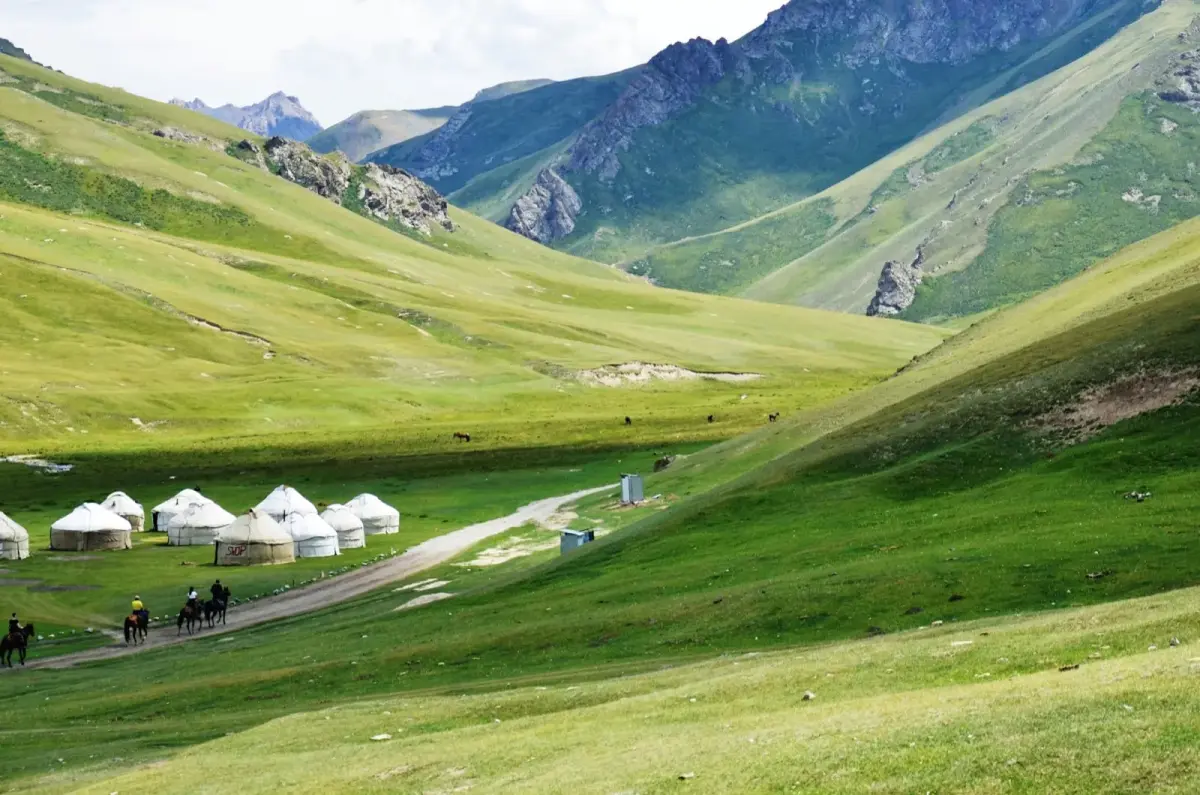
Best time to go: Summer pastures, jailoo season. A yurt can be dismantled by a family in a few hours and rebuilt somewhere else entirely — without a single nail.
Why a Yurt Was Never Meant to Be Temporary
If someone offered you a portable home today, you would probably picture a tent, a camper van, or a small modular cabin. All of them feel like a compromise between comfort and mobility.
A yurt is something entirely different.
For centuries, it was a true home for the nomadic peoples of Central Asia. Children were born here, guests were welcomed, important decisions were made, weddings were celebrated, and long winters were endured. The ability to take the dwelling apart did not make it temporary. On the contrary, it was precisely this feature that made it perfectly suited to a way of life in which the home travelled wherever the family went.
In 2014, UNESCO inscribed the traditional knowledge and skills of making the Kyrgyz and Kazakh yurt on the Representative List of the Intangible Cultural Heritage of Humanity.
The House That Moves with the Family
For most people, moving means leaving a home behind.
For nomads, it meant taking the home with them.
When the pasture could no longer feed the livestock or it was time to move to the summer highlands, the family dismantled the yurt. The lattice walls folded like an accordion, the long wooden roof poles were removed, the felt coverings were rolled into tight bundles, and every piece was loaded onto pack animals or carts.
A few hours later, everything stood again in a new place. The same walls, the same doorway, the same hearth—only with a different view beyond the entrance.
The home was never left behind.
It simply continued its journey with the people who lived in it.
Why Yurts Are Passed Down Through Generations
Most modern houses are built once and stay where they are. If a family moves, the house remains behind.
A yurt tells almost the opposite story.
A well-crafted wooden frame can last for decades. It is not rebuilt every season or replaced after each migration. The felt coverings, straps, and decorative details may be renewed over time, but the structure itself continues to serve generation after generation.
That is why yurts have often been passed from parents to their children.
It creates a remarkable paradox. A single home may stand in hundreds of different places, witness countless winters and summers, travel thousands of kilometres, and still remain the same family home.
Not a Single Nail
If you look closely at a yurt, one question naturally comes to mind: how does it stay standing?
An ordinary house depends on rigid joints, metal fasteners, and a permanent foundation. A yurt relies on none of these.
Its lattice walls form a strong circular base. Long wooden roof poles rise from the walls and meet at the central roof ring known as the tündük. The entire structure is held together by precise geometry, tension, and wide woven straps.
The result is something surprisingly rare. A yurt is sturdy enough to withstand strong winds and heavy snowfall, yet flexible enough to be completely dismantled in just a few hours.
The engineering behind this design has changed remarkably little over the centuries.
What UNESCO Is Really Protecting
At first glance, it might seem that UNESCO is protecting the yurt itself.
In reality, it is protecting something far more important.
Building a single yurt requires the knowledge of many different craftspeople. Some know how to select and shape the timber for the frame. Others make the felt from sheep’s wool. Others weave decorative bands and create the traditional interior ornaments. Together, these skills form a body of knowledge that has been passed from one generation to the next.
Without the people who know how to build a yurt, the yurt itself would soon become nothing more than a museum exhibit.
That is why UNESCO protects not the walls or the roof, but the knowledge that keeps this remarkable home alive.
Where to Experience a Living Yurt Tradition
The best place to discover this tradition is not in a museum, but where it remains part of everyday life.
Every summer, thousands of yurts appear on the high mountain pastures of Kyrgyzstan. They are especially common around Song-Kul Lake, in the Karkyra Valley, and on the jailoo pastures surrounding Issyk-Kul Lake. Many families still spend the grazing season here with their livestock, just as their ancestors did for generations.
For travellers, this is a chance to experience a living tradition rather than a reconstruction of the past.
As the sun sinks behind the mountains, horses graze nearby, fresh tea fills the yurt with its aroma, and a family gathers on felt carpets inside. In moments like these, it becomes clear why this home has endured for centuries.
Its greatest value has never been its walls.
Its greatest strength has always been that it could remain with its people—wherever the road led them.