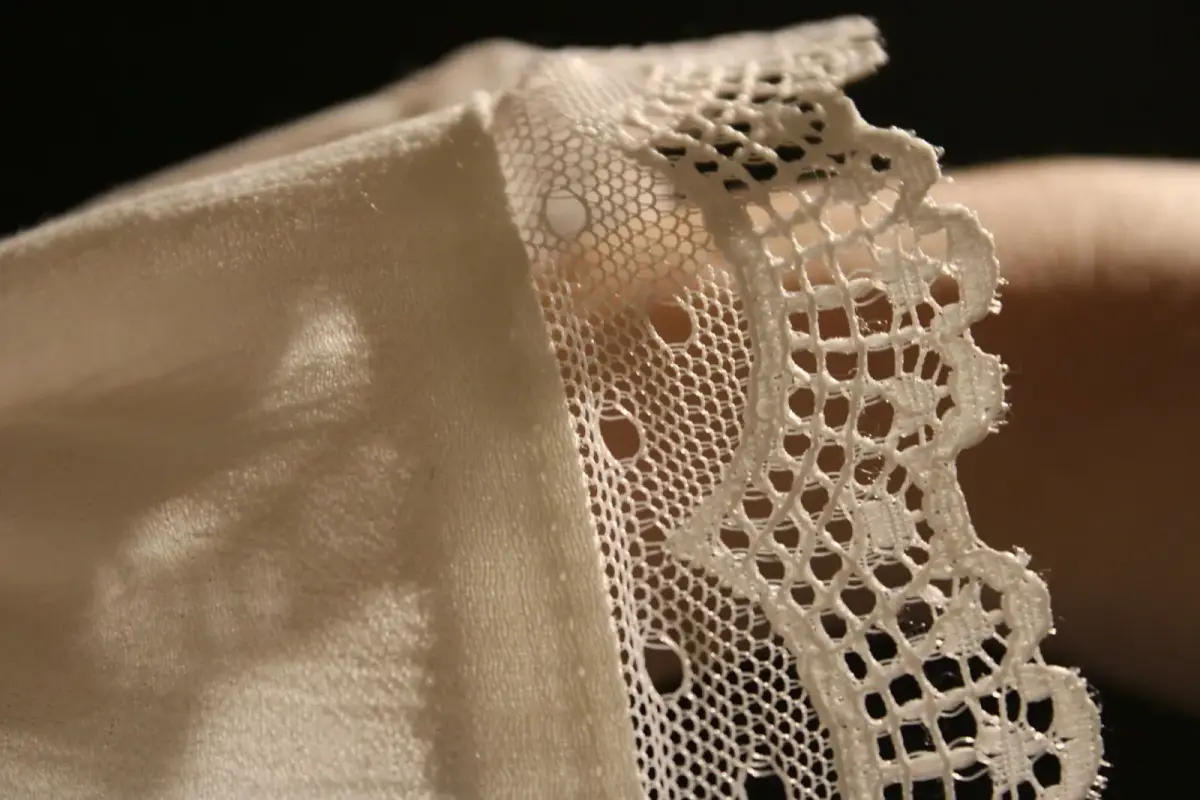
Lace looks impossibly delicate. So delicate, in fact, that it is hard to imagine how such intricate patterns can emerge from a single fine thread.
Looking only at the finished piece, it seems to be an expression of beauty, elegance, and artistic taste.
But watch the process for just a few minutes, and you begin to realise that lace-making has far more in common with mathematics than with art.
Best time to go: Workshops & schools, year-round. Made with dozens of bobbins instead of a single needle, the finest lace behaves less like textile and more like mathematics.
Almost Nothing Is Drawn
Most people picture a lace-maker working with a needle.
Yet many of the European lace-making traditions recognised by UNESCO are created in an entirely different way. Instead of a single needle, the lace-maker works with dozens—and sometimes hundreds—of wooden bobbins. Each holds its own thread, and all of them are continuously crossed and twisted around one another.
From a distance, it looks less like needlework and more like someone playing a musical instrument.
The Pattern Exists Before the First Thread
Before the work even begins, the lace-maker already knows the journey of every thread.
Which one will pass over, which one under, where they will exchange places, and where they will meet again dozens of movements later. A mistake made now may not become visible until an hour into the work.
An experienced lace-maker is not inventing a pattern as they go. They are carefully following a remarkably complex algorithm.
Every Bobbin Knows Where It Belongs
As the work progresses, the lace-maker barely looks at the wooden bobbins themselves.
Their fingers gradually memorise the position, weight, and movement of each one. Before long, the hands are working faster than the mind can consciously keep up. Skilled lace-makers often continue intricate sequences almost automatically, much like a concert pianist who no longer needs to look at the keys.
That is why mastering the craft takes years.
Why Lace Cannot Be Made Faster
Today, machines can produce lace in a matter of minutes.
Handmade lace is valued for an entirely different reason. It cannot be created simply by moving faster. Every knot depends on the one before it, and thousands of crossings must maintain exactly the right tension from beginning to end.
Some large pieces therefore require hundreds of hours of work.
Why UNESCO Protects This Craft
UNESCO is not preserving lace collars, tablecloths, or decorative fabrics.
What it protects is something far more fragile: the knowledge that allows a person to remember hundreds of consecutive movements, read intricate patterns of interlacing threads, and pass those skills on to the next generation. Across Europe, these techniques have survived for centuries through families, workshops, and dedicated lace-making schools.
If the last master disappears, more than a beautiful craft will be lost. An entire language of movement—one that cannot be reconstructed simply by studying the finished lace—will disappear as well.
The Beauty Hidden Inside Order
The first time you see lace, you notice only its lightness.
But after watching a master at work for just a few minutes, you begin to see something entirely different. The delicate threads give way to an astonishingly precise system in which every movement depends on the last, and beauty emerges not despite strict order, but because of it.
Perhaps that is why lace feels both so fragile and so perfect at the same time. It is woven not only from thread, but also from memory, patience, and an almost mathematical precision.
Where to Experience Traditional Lace-Making
Almost every European lace-making tradition offers something different. In some places, it is the extraordinary delicacy of the finished lace that leaves the strongest impression. In others, it is the astonishing speed and precision of the lace-maker’s hands. And in a few places, you can sit down at the bobbins yourself and discover just how demanding this craft really is.
🇸🇮 If You Want to Try It Yourself — Idrija, Slovenia
Idrija is one of the best places to experience bobbin lace-making for the first time.
The town has been famous for its lace for more than three centuries. Today, it is home to a lace school, a museum, and workshops where visitors can watch demonstrations and join hands-on classes. It takes only a few minutes to realise that the greatest challenge is not the fine thread itself, but keeping track of dozens of wooden bobbins that are constantly changing places.
It is one of the few places where you can not only see the craft, but experience it with your own hands.
🇭🇷 If You Want to Compare Different Traditions — Croatia
Croatia is unique because UNESCO recognises three distinct lace-making traditions within the country.
On the island of Pag, lace is made with a needle, while in Lepoglava it is created using bobbins. Although the finished pieces may appear similar, the techniques behind them are entirely different. Few places offer such a clear opportunity to see how the same artistic idea evolved into completely different crafts.
🇧🇪 If You Want to See the Lace Once Worn by European Royalty — Belgium
Bruges and Brussels have long been regarded as the spiritual home of Belgian lace.
Museums, specialist workshops, and lace centres continue to preserve centuries-old techniques, with skilled artisans still creating intricate pieces entirely by hand. Belgian lace became famous for its astonishing refinement—some details are so delicate that it is difficult to believe they were made by human hands.
Which Destination Is Right for You?
If you want to understand why lace-making feels more like mathematics than art, Idrija is the perfect place to begin. Sitting behind a lace pillow with a handful of bobbins transforms the way you see the craft.
If you are more interested in comparing different traditions, Croatia offers the richest experience, bringing together several distinct UNESCO-recognised techniques within a single country.
And if you want to see the form of lace that became the benchmark of European craftsmanship for centuries, Belgium is the obvious choice. It is here that you begin to understand why the finest handmade lace was once valued almost as highly as precious jewels.