Best time to go: Workshops year-round. A Persian carpet can hold a million hand-tied knots, and every one of them was placed by memory, not by a machine.
A Carpet That Holds Time
A Persian carpet may seem like nothing more than a beautiful piece of textile. Your eyes are drawn to its intricate patterns, rich colours, or soft wool. Yet there is something hidden beneath the surface that you cannot see at first glance: a single carpet may contain hundreds of thousands, and sometimes even several million individual knots.
Every one of those knots was tied by hand. Not one appeared on its own. While we see a finished carpet as a single work of art, the weaver sees something entirely different—a seemingly endless sequence of small, deliberate movements, each adding only a few millimetres to the finished piece.
One Knot Means Nothing
A single knot seems almost insignificant. It is too small to change the design and too simple to be considered art on its own. Yet every Persian carpet begins with one knot, then another, and another after that.
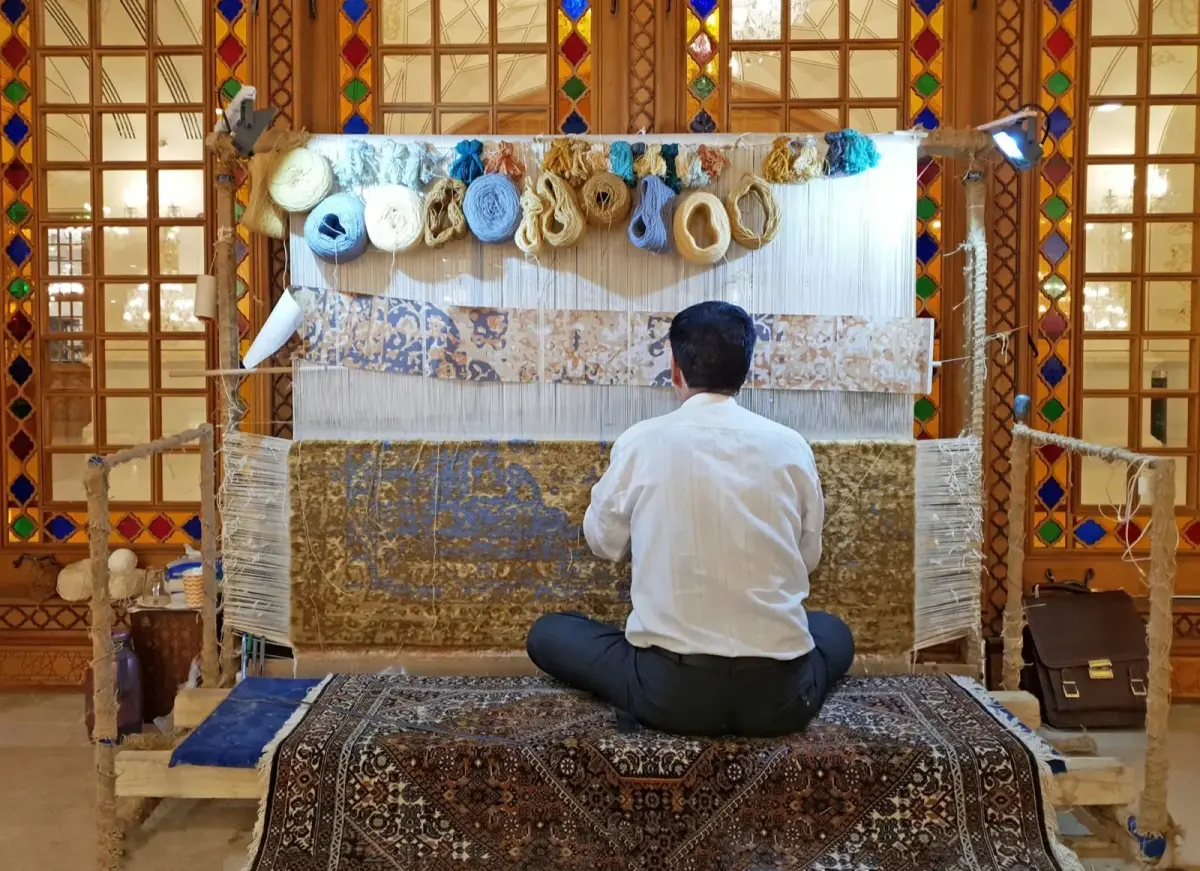
The process starts with the warp threads stretched tightly across the loom. The weaver ties a knot by hand, pulls it tight, trims the yarn, and moves on to the next one. After several rows, the knots are packed together with a heavy comb to create a dense, durable fabric. Day after day, the pattern grows so slowly that during the first weeks it can be difficult to imagine what the finished carpet will eventually look like.
Why the Process Cannot Be Rushed
Modern machines can produce carpets that resemble handmade ones, but traditional Persian carpet weaving follows a completely different logic. Every knot must be tied in exactly the right place because the entire pattern depends on the precise position of each individual knot.
Speeding up the process would mean changing the craft itself. The value of a handmade carpet comes not only from its wool, silk, or natural dyes, but also from the extraordinary precision required to repeat the same careful movement hundreds of thousands of times. That is why traditional carpet weaving remains a craft that cannot simply be accelerated without sacrificing its character.
A Craft Passed Down Through Generations
Creating a Persian carpet requires far more than patience. It also requires knowledge that has been handed down through families for generations. In Iran’s Fars Province, mothers traditionally teach their daughters how to spin wool, dye yarn, and weave carpets, while fathers teach their sons how to shear sheep and build the looms themselves. In Kashan, girls likewise learn from their mothers and grandmothers, while men traditionally specialise in designing patterns, preparing dyes, and making weaving tools.
Every finished carpet therefore carries more than the work of a single artisan. It also preserves the knowledge of countless weavers who learned these skills long before the carpet itself ever existed.
When Millions of Knots Become Art
People admire Persian carpets for their fine wool, delicate silk, natural dyes, and intricate designs. Yet none of these materials would have the same value without the one ingredient that cannot be seen: human time. It cannot be bought separately or displayed on a wall, but it is woven into every knot.
This is why UNESCO did not recognise the carpets themselves as Intangible Cultural Heritage. Instead, it recognised the traditional skills of carpet weaving in Fars and Kashan, acknowledging that the true heritage lies in the knowledge, craftsmanship, and traditions passed from one generation to the next. As long as another weaver sits at the loom and ties the next knot, that heritage continues to live.
Where to See Traditional Persian Carpet Weaving
The best way to understand this craft is not by visiting a carpet shop but by stepping inside a working workshop. Watching a weaver at the loom, even for just a few minutes, makes it immediately clear why creating a single carpet can take months—or even years. Only then do the hundreds of thousands of knots stop being an abstract number and become something tangible.
One of the best places to experience this tradition is Kashan, whose carpet-weaving skills were inscribed on UNESCO’s Intangible Cultural Heritage list in 2010. The city is home to workshops where carpets are still woven by hand, as well as the Carpet Museum, where historic masterpieces are displayed alongside the story of how they are made.
The second UNESCO-recognised tradition survives in Fars Province, particularly among nomadic communities. Here, carpet weaving remains part of everyday family life, with skills passed naturally from parents to children. Visiting the region offers a chance to witness not a museum demonstration, but a living tradition that continues much as it has for generations.